
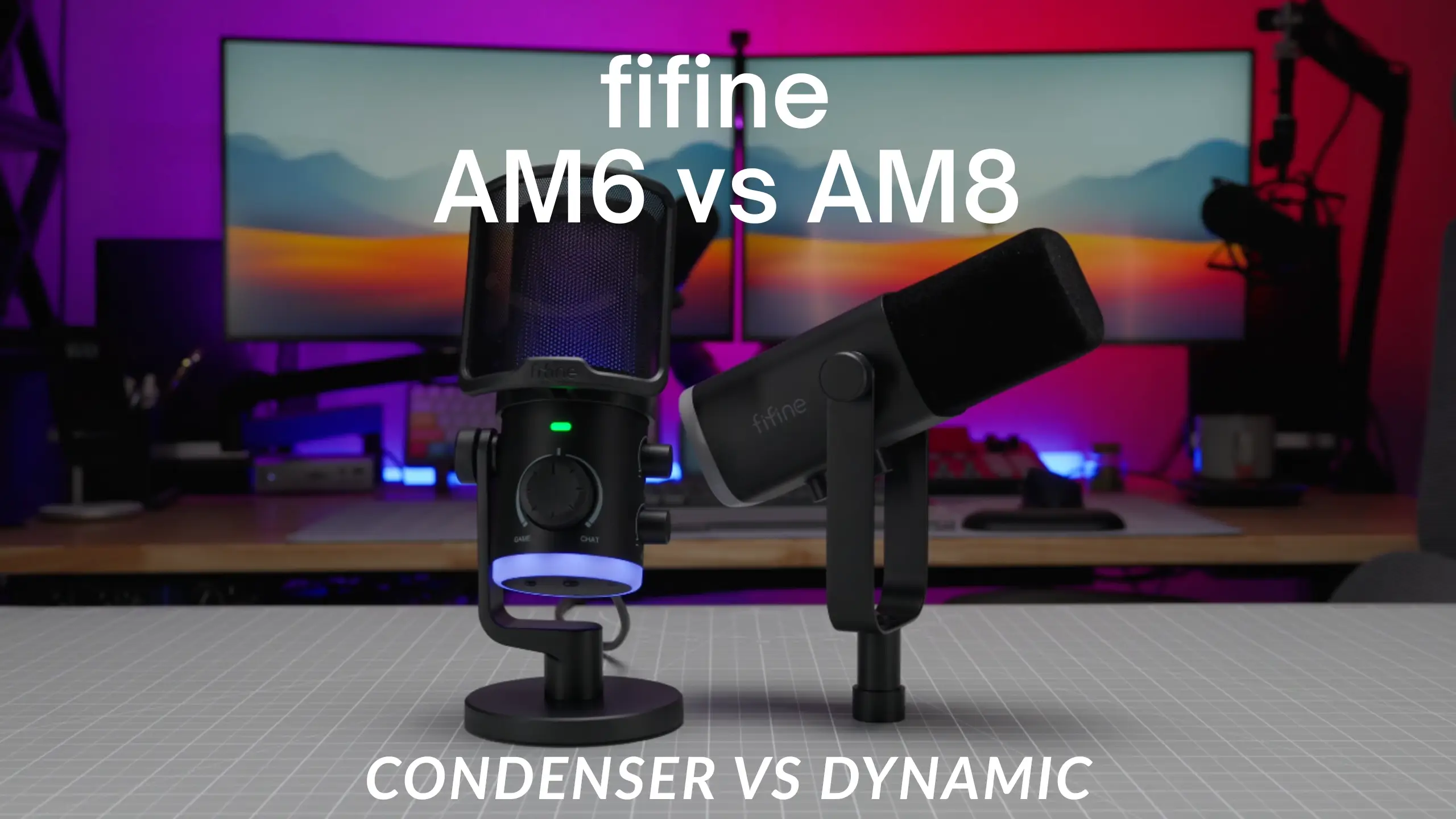
fifine AM6 vs AM8: Should You Buy A Condenser or Dynamic Microphone?

Does fifine AM6 behave and have features like the fifine AM8? No sincerely. When it comes to fifine AM6 vs AM8, the AM8 wins overall because a dynamic capsule plus a real XLR output means the mic can grow with you. The AM6 wins the moment you stop treating a microphone like a studio tool and start treating it like a gaming peripheral. Which microphone actually suits you? Here’s a detailed comparison guide, so you can find one that works best for you.
Quick Verdict about fifine AM6 vs AM8
fifine AmpliGame AM8
| Pros | Cons |
|---|---|
| 🟣Combo USB-C and XLR, usable at the same time 🟣Dynamic capsule adds low-mid weight with no processing 🟣Grows with you when you buy an audio interface 🟣Less sensitive to general room noise 🟣Larger body and metal grille look the part on camera 🟣Weighted desk stand plus a yoke mount plate included | 🟣Wants to be 2 to 6 inches from your mouth 🟣No game/chat balance control 🟣No noise cancellation button 🟣Its low-end lift makes hums and fan noise more audible (A boom arm can solve it) 🟣Foam windshield instead of a proper pop filter |
fifine AmpliGame AM6
| Pros | Cons |
|---|---|
| 🟣Front knob balances game and chat audio 🟣Dedicated noise cancellation toggle 🟣Stays clear and loud from up to 12 inches away 🟣Compact, light and easy to tuck into a setup 🟣Removable pop filter that actually works 🟣Wider frequency response leaves more room to edit | 🟣USB-C only — no XLR, so no upgrade path 🟣Thins out noticeably if you back off without adding gain 🟣Condenser sensitivity picks up more ambient room noise 🟣Noise cancellation costs a little audio quality 🟣Smaller desk stand, less presence on camera |
fifine AM6 vs AM8: Detailed Measurements
Capsule type and voice character
This is the fork in the road. The AM8 is a dynamic mic. The AM6 is a condenser. Both use a cardioid pickup pattern, so both concentrate on what sits directly in front of them.
It’s the decision between a condenser vs. a dynamic microphone. The dynamic capsule in the AM8 leans into mids and lows. @Vrtuhub described the AM8 XLR mode as the deeper “radio voice” — the sound you get with almost no post-processing. “This is perfect for you if you just want to sound like a pro”, he said.
The AM6’s condenser capsule captures a wider frequency range and lands much closer to your natural speaking voice. Less immediately impressive, more raw material to work with. If you EQ, compress or sing, that headroom matters.
Winner: split. AM8 if you want to sound finished straight out of the box. AM6 if you plan to edit.
Distance and placement tolerance
fifine recommends 2 to 6 inches for the AM8 and up to 12 inches for the AM6 — and every reviewer’s experience matched that spec.
Creator @gtpcs tested the AM6 at roughly 6 inches, then 8 inches, then almost touching the pop filter. Close up, it sounded crisp. Backed off, it thinned out until he raised the output. His honest read: the AM6 needs your mouth close, or it needs gain.
That said, @Vrtuhub cranked both mics to maximum gain, set them on their included desk stands, and talked from a normal gaming posture. “The AM8 sounds fine if you’re further away as well, but AM6 sounds a bit nicer if you’re further away”. And he explains, “It is a condenser capture. It’s more sensitive, so it sounds really good if you’re further away”.
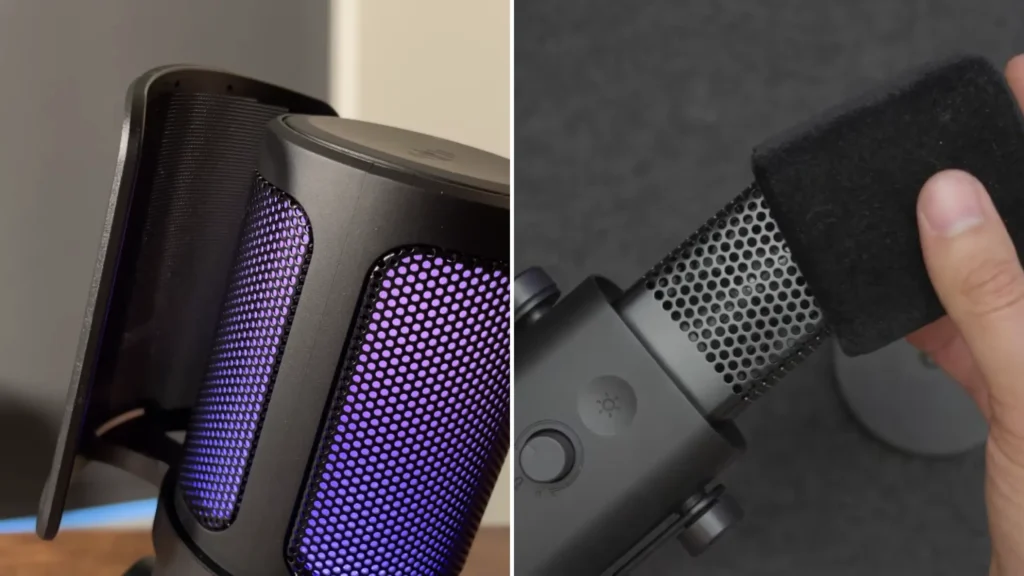
Winner: AM6, if you won’t or can’t keep the mic near your face. The AM8 handles distance acceptably — it just doesn’t reward it.
Connectivity
XLR vs USB microphone? The AM6 is USB-C, plug-and-play. One cable powers it, lights the RGB and sends audio to your computer.
The AM8 does USB-C and XLR, and one reviewer confirmed you can run both simultaneously. You can have the mic connected to your phone over USB for a live conversation while an audio interface records a clean, uncompressed backup off the XLR. It’s also the upgrade path: start with USB mode when you’re new. Want to update to an XLR mic? The XLR mode comes with you instead of getting shelved.
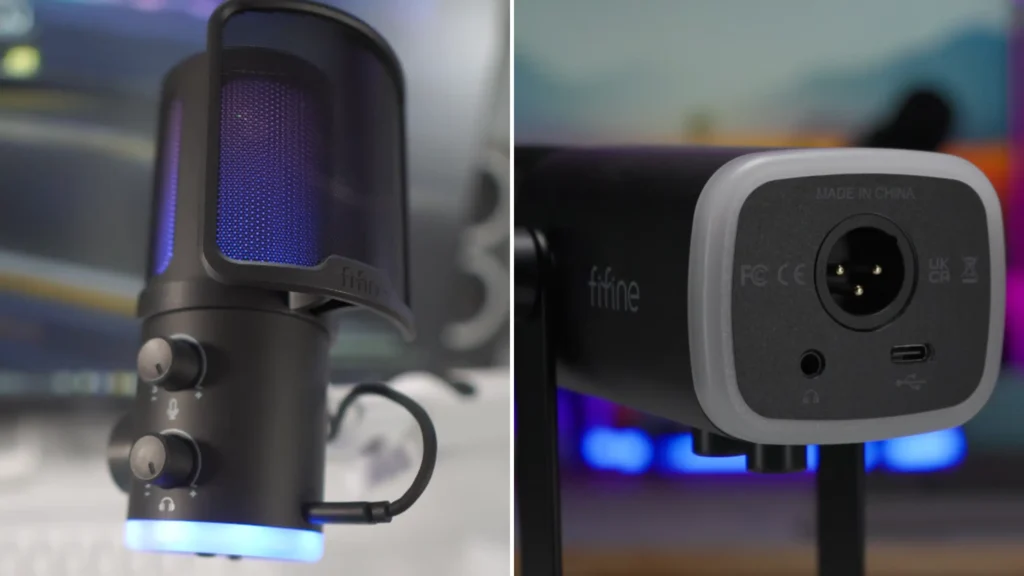
An interface like fifine SC8 with fifine AM8 microphone can change things. @Vrtuhub connects AM8 with a podcasting interface that applies hardware EQ and compression. More bass, less treble, and levels evened out. An interface with the wrong settings? The AM8 XLR mode sounds worse than plain USB.
Winner: AM8. Clearly, the XLR and USB dual connectivity is the win-win.
Onboard controls
Both mics give you a gain knob, a headphone monitoring knob, a 3.5mm jack for monitoring, a touch-sensitive mute in different spots — tap the top of the AM6 and the indicator goes from green to red — and a dedicated button for cycling RGB modes and static colors.
The AM6 adds two things the AM8 doesn’t have.
- A front-mounted knob that balances game and chat audio. Squadmate calling out something important? Turn them up. Explosions drowning everyone out? Turn the game down.
- A noise cancellation toggle on the underside. A reviewer thinks the audio quality drops a little with it engaged, but it does the job it claims to do.
The AM8 counters with a slightly better windshield story. It ships with foam; the AM6 ships with a removable pop filter that is fully effective at its job.
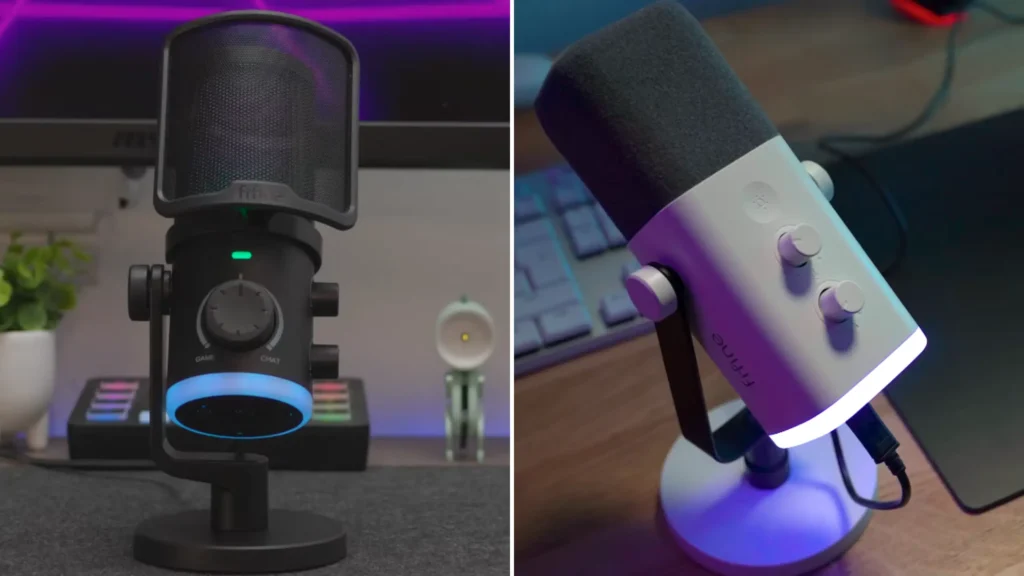
Winner: AM6. The chat balance knob is the single most useful control on either mic if you play multiplayer.
Size, stands and desk footprint
The AM8 is noticeably bigger, with a rectangular body and a metal grille. The AM6 is a compact cylinder — light, small, easy to tuck away. Both stands are weighted metal with anti-slip rubber on the bottom, and both mics thread 3/8-inch and 5/8-inch so they’ll take any standard boom arm. The AM8 also includes a yoke mount plate for attaching it to a desk stand.
Neither reviewer had a complaint about either desk stand, and that’s the point: on a strict budget, both work on the desk as shipped. A boom arm is still the upgrade, and it matters more for the AM8, which wants to be close to your mouth.
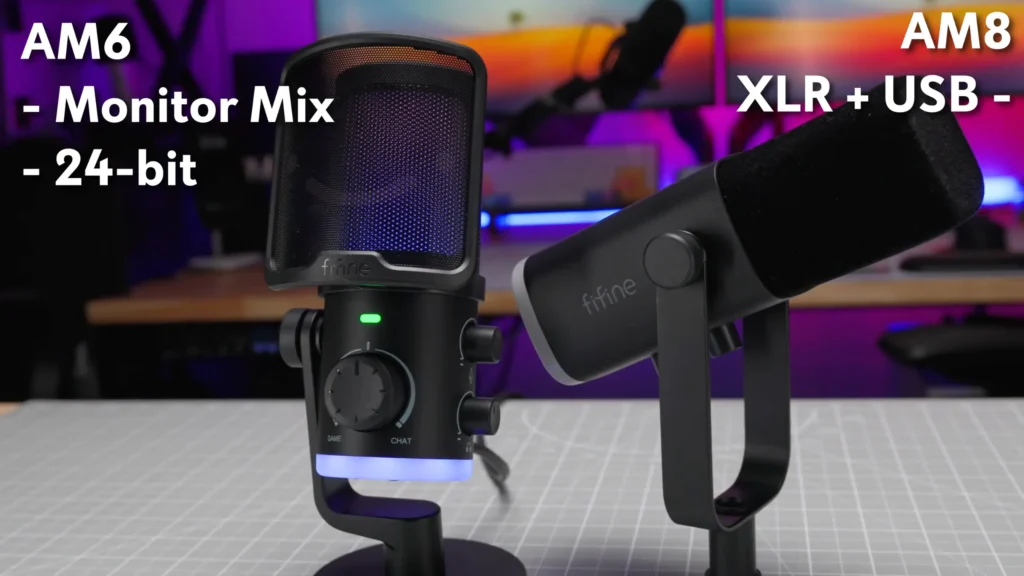
Winner: split. AM6 for tight desks and cable-managed setups. AM8 if you want the mic visible on camera — the larger body and grille photograph better.
Background noise handling
The dynamic microphone AM8 should win for the noise reduction. That said, the dynamic capsule’s low-mid emphasis deepened the hum, like the cooling fans, and made it more audible. Easy to remove in post, but a useful reminder: the AM8’s flattering low end flatters your room’s low end too.
For the condenser microphone fifine AM6, it’s more sensitive and more easily picks up room noise. But the dedicated noise cancellation button is the AM6’s counter, which the AM8 doesn’t have. Plus, the fifine AM6T microphone kit (AM6+boom arm) lets the mic be far away from the desk, so as to reduce low-mid noise.
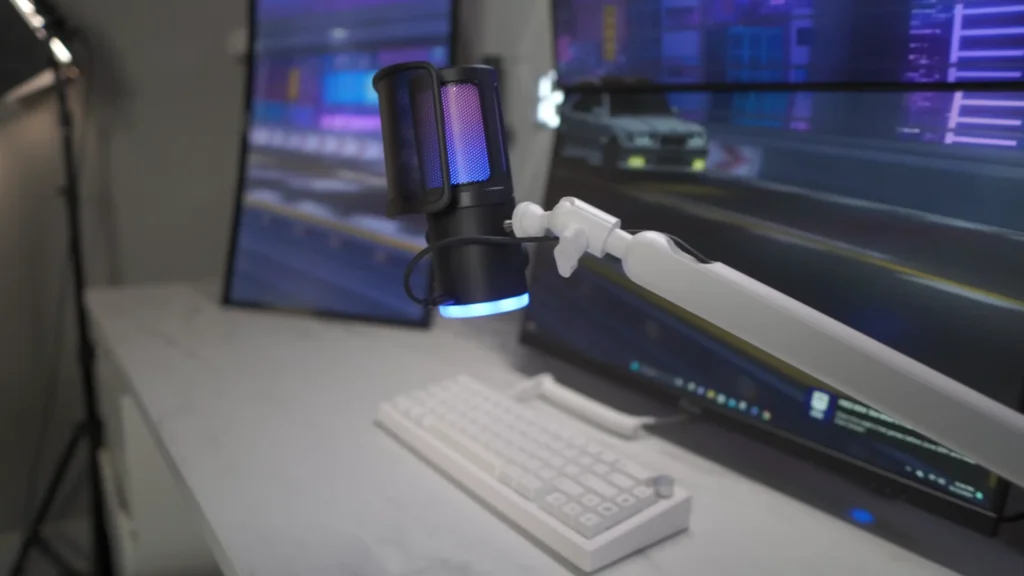
Winner: AM8, narrowly. Less sensitive overall. Just don’t sit it near anything that hums.
When to Choose the fifine AM6 vs the AM8
Run your own setup through this. Most people land on one side within two or three rows.
| Pick | If this is you… | Why |
|---|---|---|
| fifine AM6 | You play multiplayer and juggle game audio against Discord | The front knob rebalances both mid-match without alt-tabbing. |
| The mic will sit on your desk, not on a boom arm | The condenser stays clear at arm’s length; the AM8 wants 2 to 6 inches. | |
| You sing, or you EQ and compress everything in a DAW | Wider frequency response gives you more to shape later. | |
| Your desk is cramped or the mic needs to disappear | Compact cylinder body and a smaller weighted stand. | |
| You record next to fans, PC intake or hot studio lights | Dedicated noise cancellation, and no low-end lift to deepen a hum. | |
| fifine AM8 | You’re starting a stream, podcast or voiceover channel | The XLR output means the mic survives your next three upgrades. |
| You want to sound good with zero processing | The dynamic capsule adds low-mid weight straight out of the box. | |
| You already own an audio interface, or plan to buy one | Real-time hardware EQ and compression, plus a clean backup recording. | |
| The mic will be on camera | The larger rectangular body and metal grille frame better on video. | |
| You want one mic for phone calls and a recorded backup | USB and XLR run at the same time — talk on one, capture on the other. |
fifine AM6 vs AM8, Which One Do You Pick?
fifine AM6 vs AM8? Here’s the honest tiebreaker: the AM8 flatters your voice; the AM6 flatters your workflow.
The AM8 is the overall winner for a stream, a podcast, or a voiceover channel. It’s the mic you won’t outgrow the week you buy an audio interface. Buy the AM6 if you’re a gamer. The chat balance knob, the condenser capsule, and the compact body disappear into a setup.
Not quite what you’re after? fifine microphone reviews go deeper on each mic individually. From streaming microphone to recording mics, fifine knows your needs.
FAQ
Can I use USB and XLR on the AM8 at the same time?
Yes. One reviewer confirmed it — useful for talking through your phone over USB while an interface captures a clean XLR backup.
Which is better for background noise?
The AM8 in most rooms, since dynamic capsules are less sensitive. But its low-end emphasis makes hums and fan noise more noticeable. The AM6 has a dedicated noise cancellation button as a counterweight.
Do they work with PS5 or Xbox?
Both fifine AM6 and AM8 do, along with PC, Mac, PS4, and mobile devices. But they both don’t work with Xbox.
Do I need a boom arm?
No — both include a weighted desk stand that works fine. The AM8 benefits more from one, since it wants to be 2 to 6 inches from your mouth. Both mics take 3/8-inch and 5/8-inch threads.
Does the AM6’s noise cancellation hurt audio quality?
Slightly, per the Spanish-language review. Still worth using in a noisy room.
