
Microphone Sensitivity: What It Means and Why It Matters

Have you read the microphone specification charts when picking a mic? There’s one spec that you may easily ignore but would make a big difference for your recording quality: microphone sensitivity. Too low for your setup, you’ll fight the noise. Too hot for a loud source, you’ll fight distortion.
What is microphone sensitivity, and how does it actually work? We’ll break it down in this guide. Everything below is grounded in how mics are actually measured and rated, with real models as reference points, so the numbers mean something.
What Is Microphone Sensitivity?
Sensitivity is a microphone’s efficiency at converting sound into voltage.
A mic does one core job: it turns the mechanical energy of a sound wave into electrical energy. The mechanical side is the sound pressure level (SPL) hitting the diaphragm, measured in pascals or decibels. The electrical side is the output voltage, measured in millivolts or dBV. Sensitivity is the ratio between the two – how much voltage you get out for a given amount of sound pressure going in.
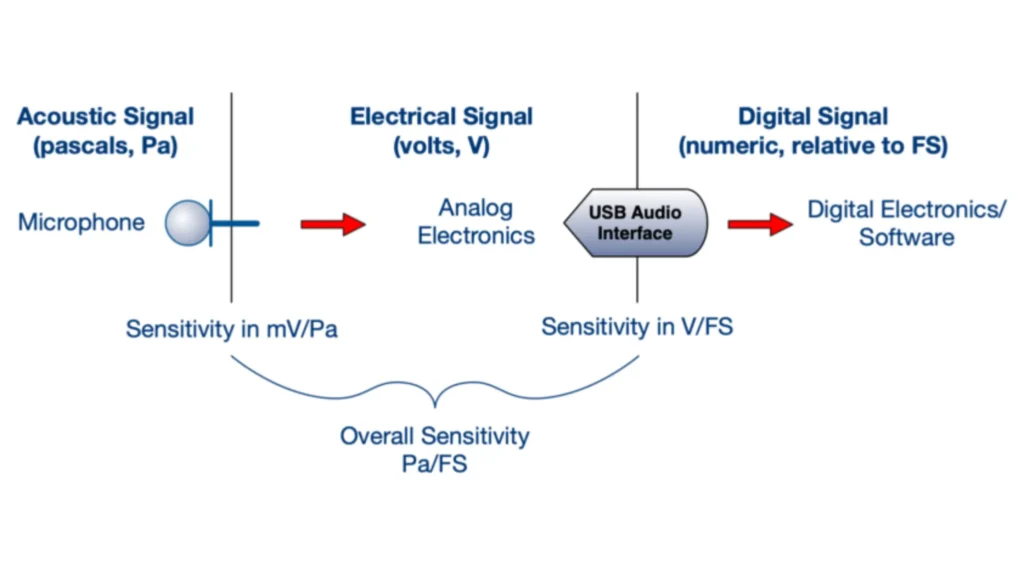
For the same loudness, a higher-sensitivity mic produces more output voltage than a lower-sensitivity one. Put two mics in front of the same source, and the more sensitive one hands your interface a stronger signal before you touch a single knob.
One thing you may confuse: sensitivity is almost always written as a negative number, and a number closer to zero means more sensitive. A mic rated -34 dB is more sensitive than one rated -60 dB.
How Does Microphone Sensitivity Work?
There’s the same way to compare mics fairly: they apply one pascal of sound pressure using a standard 1 kHz sine wave, then measure the output voltage. For reference, one pascal equals 94 dB SPL — roughly the level of a loud shout up close.
From there, the microphone sensitivity has two units: mV/Pa and dB.
Europe uses the output voltage directly. The unit is millivolts per pascal (mV/Pa), and it’s often called the transfer factor. It’s refreshingly literal: it tells you how many millivolts you get for one pascal of pressure. A mic at 21 mV/Pa simply puts out 21 millivolts when hit with one pascal.
The USA compares that output against a hypothetical, highly efficient mic — one assumed to produce a full volt (1,000 mV) per pascal. The formula looks like this:
Sensitivity (dBV) = 20 × log₁₀ (transfer factor ÷ 1000)
Take a shotgun mic like the Sennheiser MKE 600, which lists 21 mV/Pa on phantom power. Drop 21 into the formula against the 1,000 mV reference, and you get about -33.56 dB. Bump the transfer factor up to 50 mV/Pa, and sensitivity climbs to -26 dB — closer to zero, so more sensitive. Also, this mic lists a lower 19 mV/Pa figure on battery power. So, how you power a mic can shift its output.
But where do the decibels come from? From that 1 pascal = 94 dB relationship. Sound pressure level itself is a logarithmic measurement — 20 × log₁₀ of the measured pressure over a reference pressure — which is why mic output ends up expressed in dB too.
Three things inside the mic shape its sensitivity:
- How reactive the diaphragm is to different sound pressure levels.
- The mic type — dynamic vs condenser, for instance.
- Any amplification of the signal is built into the mic itself.
Typical Sensitivity by Microphone Type
Different mic designs land in predictable ranges, which is handy when you’re scanning specs. Here’s the lay of the land:
| Mic type | Typical sensitivity (dB rel. 1V/Pa) | What it means for you |
|---|---|---|
| Dynamic & passive ribbon | -60 to -44 dB | Lower output; needs more clean gain to reach a usable level |
| Condenser & active ribbon | -42 to -30 dB | Higher output; easier to drive, better for quiet sources |
Dynamic mics like the Shure SM58 are usually passive — no phantom power needed, but low sensitivity. The SM58 sits around -54.5 dB, putting out roughly 1.85 mV at 94 dB. That’s why dynamics ask for more gain to get going, and why a clean preamp matters so much with them.
You’ll see the same pattern across affordable dynamics. The FIFINE K688, a cardioid dynamic, is rated at -50±3 dBV — squarely in the typical band, and a level most interfaces handle with a modest gain bump. The FIFINE Tank6, also a cardioid dynamic, sits even lower at around -74±3 dB. They lean on a clean, capable preamp and good close-mic technique to reach a full signal.

Condensers run hotter. The RØDE NT1 is around -29 dB (about 35 mV/Pa) and is also famous for an extremely low self-noise of 4.5 dBA. The FIFINE K669B is a uni-directional condenser rated -43±3 dB at 1 kHz. That sits right at the edge of the condenser band — hotter than a typical dynamic, so it’s easy to drive for desktop voice and streaming without piling on gain.
Does High Sensitivity Mean Better Sound?
Does the condenser -29 dB sound better than the dynamic at -54 dB? It doesn’t work that way. Sensitivity measures output efficiency, not how good that sound is. A more sensitive mic just hands your interface a stronger signal. It tells you nothing about tone, clarity, or how the mic flatters your voice and your room.
The right sensitivity is the one that suits your source and your setup, and that’s where the real trade-offs show up.
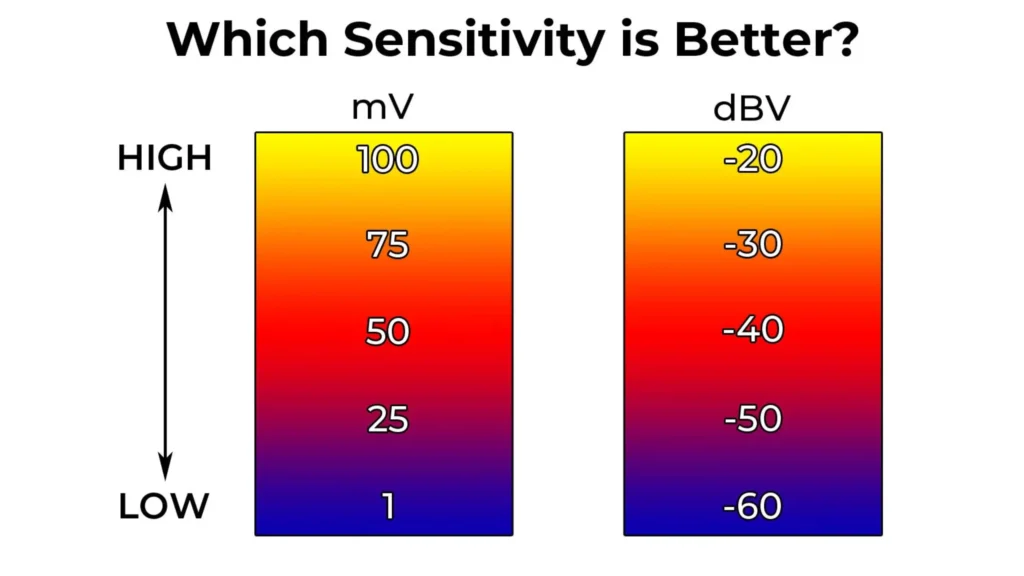
The takeaway: match the mic to the job. Recording a soft, low-volume source? A sensitive mic saves you from over-amplifying. A loud or close, booming voice? A less sensitive dynamic gives you headroom before things break up.
Sensitivity vs Gain
Sensitivity and microphone gain both affect how loud your recording ends up, but they are not the same thing — and one of them you can’t change at all.
| Sensitivity | Gain | |
|---|---|---|
| What it is | The mic’s built-in ability to convert sound into a signal | How much you amplify the signal after it leaves the mic |
| Where it happens | Inside the mic, at the diaphragm and electronics | At your interface, mixer, preamp, or in your editor |
| Can you change it? | No — it’s fixed at the factory | Yes — turn the knob |
| Effect on noise | Tied to the mic’s polar pattern and self-noise | Boosts signal and noise equally |
| Best thought of as | The lens on a camera (fixed light intake) | Brightening the photo in post |
Take a camera. Sensitivity is like a basic lens. It lets through a fixed amount of light based on how it was built. Gain is like brightening or darkening that photo afterward in editing. You’re tweaking the image, not the lens.
And gain doesn’t single out the parts you want louder. Turn it up and everything comes up proportionally — your voice, the air conditioner, the keyboard, the dog two rooms over.
How to Read Sensitivity and Get Started
Here’s how to put all of this to work, whether you’re buying or recording.
1. Find the number — and don’t trust vague claims. A trustworthy mic lists its sensitivity, often in the technical specs or on the manufacturer’s site rather than the retail page. It’s also worth checking the actual spec, since marketing and reality don’t always match — one mic has been spotted claiming -47 dB in a product image while the box itself reads -38 dB.
2. Know what’s “good” for an entry-level mic. For everyday streaming, gaming, and YouTube voice work, here’s a rough scale:
- Around -32 dB is a strong value — territory you’ll find on something like the RØDE NT at roughly -31.9 dB.
- Around -34 to -35 dB is a solid budget pick. You can nudge the level up in your editor and still land in good shape.
- Around -38 to -39 dB or worse gets painful. These tend to need so much added gain that you introduce noise and lose voice detail trying to rescue them.
And don’t assume small gaps are trivial. A -38 dB mic can need two or three rounds of boosting to match a -34 dB one, and each round piles on hiss.
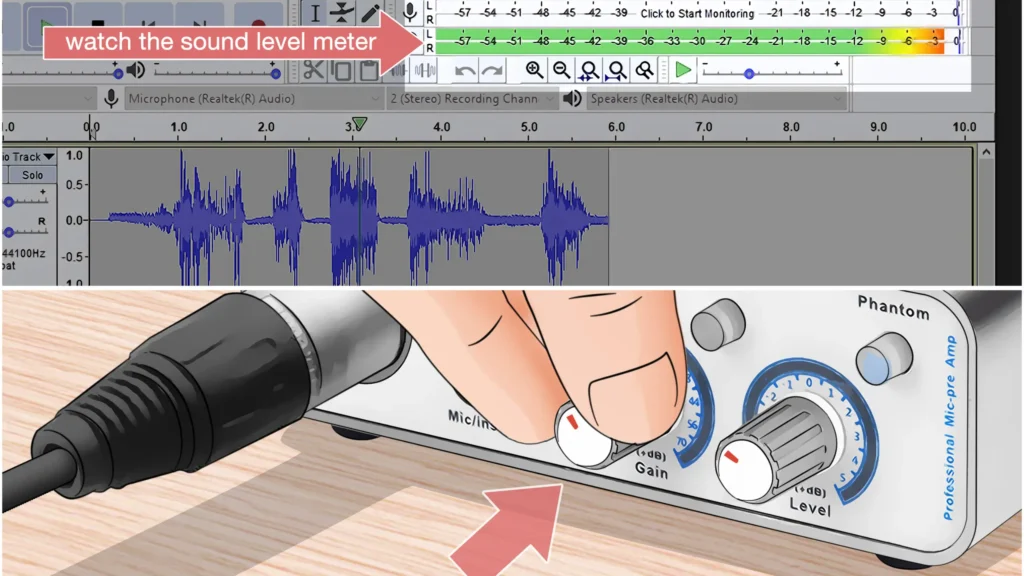
3. Set the gain properly instead of fixing it later. Microphone placement matters. Get close to the mic — around two inches in an untreated room and angle slightly off-axis if you’re popping. Then bring your gain up while you talk until your loudest moments sit just below clipping, and pull it back a touch for safety. You’re maximizing your signal-to-noise ratio at the source, which beats any amount of post-production cleanup.
4. Match self-noise to your room. Sensitivity has a quiet partner: self-noise (or equivalent noise level). On large-diaphragm condensers, under about 12 dBA is excellent, above 14 dBA starts showing up in a quiet studio, and above 20 dBA is a genuinely loud mic. But if your room already sits at a 30 dB noise floor, that room noise tends to mask the mic’s self-noise — so an ultra-low-noise mic matters far less than it would in a treated booth.
The Bottom Line
Microphone sensitivity is just a measure of how efficiently your mic converts sound into a signal — a fixed number you read, not a setting you change. Learn to see it on a microphone specification sheet, match it to your source and your room, and set your gain at the source. You’ve solved most of the “why does my audio sound thin and noisy” problem before it starts.
Ready to put it into practice? Check out our guide to the best USB microphones for streaming and podcasting to find a model with the right sensitivity for your setup.
FAQ
Is a higher or lower sensitivity microphone better?
Neither is universally better. A higher-sensitivity mic (closer to zero, like -32 dB) suits quiet sources and needs less gain. A lower-sensitivity mic gives you more headroom for loud sources. Match the spec to what you’re recording.
What does a negative dB sensitivity rating mean?
It’s a comparison against a hypothetical perfect mic that would produce 1 volt per pascal. Every real mic falls short, so the result is negative. The closer to zero, the more sensitive. -30 dB is more sensitive than -50 dB.
Does turning up the gain increase microphone sensitivity?
No. Sensitivity is fixed when the mic is built. Gain amplifies the signal after it leaves the mic and raises your voice and background noise equally. The two are often confused, but they do different jobs.
What is a good sensitivity for a streaming or gaming microphone?
Around -32 dB is excellent, and -34 to -35 dB is a solid budget choice. Try to avoid mics rated around -38 dB or worse, since they usually need heavy gain boosts that add noise.
What’s the difference between mV/Pa and dB sensitivity ratings?
They describe the same thing in two ways. Millivolts per pascal (the transfer factor) states output voltage directly and is common in Europe. The dB rating compares that output to a 1V/Pa reference and is common in the USA. You can convert between them.
