
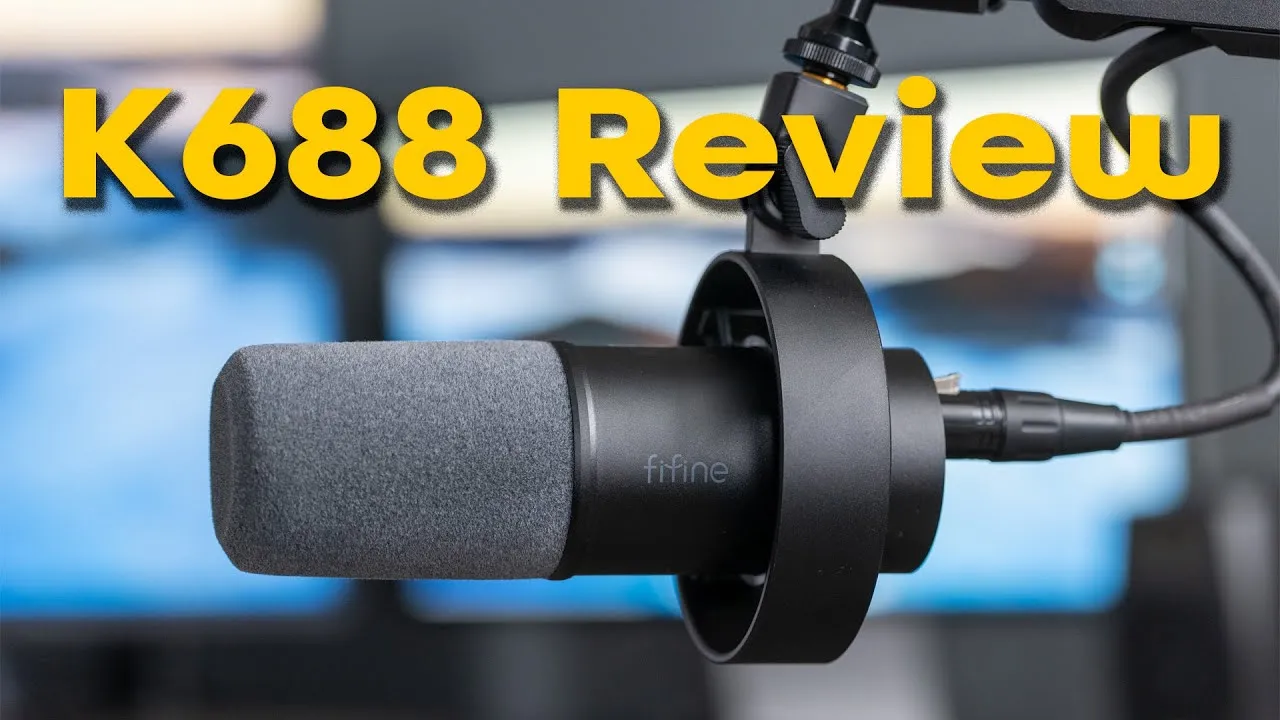
FIFINE K688 Review: The Budget Mic That Punches Above Its Weight

Priced between $72-83, depending on sales, the K688 is FIFINE’s answer to everyone who looked at the Shure SM7B’s $400 price tag. For “affordable”, it might sound like “you’re recording in a tin can during a thunderstorm”. But FIFINE K688 here to challenge that assumption—and based on extensive testing, it mostly succeeds.
For the FIFINE K688 review, we tested the microphone across different setups (USB direct to computer, XLR through various interfaces), and compared it against competitors ranging from the budget-friendly Maono PD400X to the industry-standard Shure SM7B. Here’s what we found.
Quick Check about FIFINE K688 Review
Overall Score: 8.0/10
| Category | Score |
| Sound Quality | 8.0/10 |
| Build Quality | 7.5/10 |
| Features & Functionality | 8.5/10 |
| Plosive & Noise Handling | 7.0/10 |
| Value for Money | 9.0/10 |
| Competitor Comparison | 8.0/10 |
Pros
- Dual USB-C and XLR connectivity for maximum flexibility
- Clean, punchy sound that rivals mics costing 3-4x more
- Built-in mute button with visual LED indicator
- Solid build quality with included shock mount
- No phantom power required—plug and play
- Complete kit with 8.2-foot USB cable and thread adapter
Cons
- USB mode capped at 16-bit/48kHz (competitors offer 24-bit)
- The windscreen could be thicker for better plosive rejection
- Rear-mounted controls are less convenient for live adjustments
- Fixed cardioid pattern limits use cases
- Lightweight feel may concern some users
Sound Quality Review in FIFINE K688
Score: 8.0/10
As a dynamic microphone, the FIFINE K688 microphone exhibits the expected proximity effect: move closer and your voice takes on a deeper, richer character; back away and things thin out. The sweet spot sits at about 3-4 inches from the capsule, where you get a full, professional sound without overwhelming bass.
USB vs. XLR Performance
Here’s where the FIFINE K688 review shows. The K688 sounds noticeably different depending on how you connect it. Through XLR (tested with interfaces like the Focusrite Scarlett 2i2 and Connect 6), the microphone delivers a warmer, beefier tone with more control over your signal chain. USB mode is convenient but comes with limitations—notably the 16-bit/48kHz cap that some competitors exceed.
That said, for most content creators, the USB sound quality is more than adequate. The convenience of USB plug-and-play (it’s class-compliant, so your device recognizes it immediately) may well outweigh the marginal quality bump from XLR for many users.

The Low-End Question
Multiple reviewers noted a slight quirk in the low-mid frequencies—a subtle muddiness or “strange resonance” that some found distracting. The consensus solution? A gentle low-cut filter or EQ adjustment in post-production cleans this up nicely. If you have a naturally lower voice, you may actually appreciate this characteristic. If not, plan to spend 30 seconds tweaking your audio settings.
FIFINE K688 Build Quality Review
Score: 7.5/10
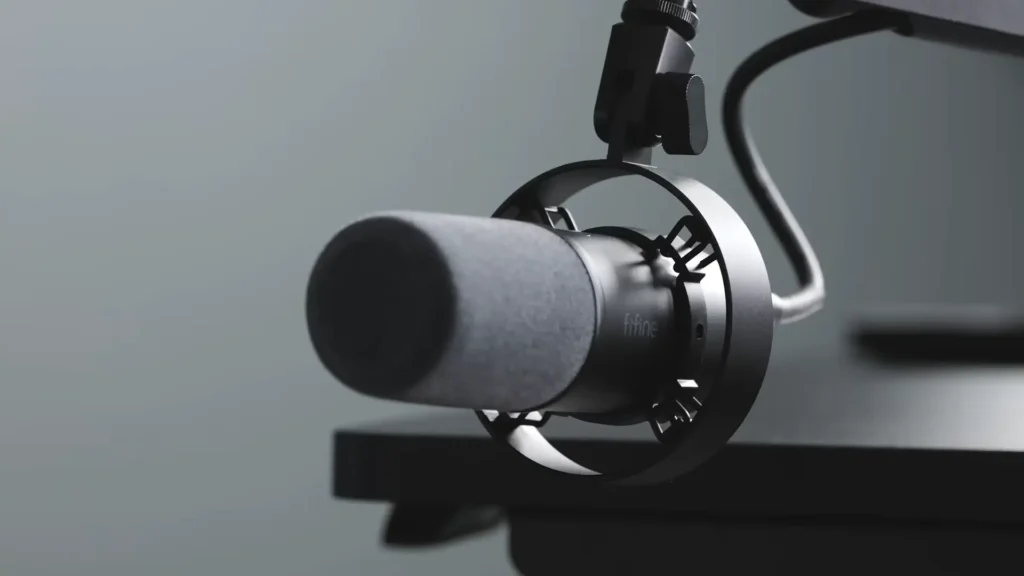
The K688’s build quality tells a story of smart compromises. The body is mostly metal with a shock mount that’s permanently screwed into the microphone—no separate purchase required. Available in pearl white, matte black, and even pink, the design leans into a modern aesthetic that one reviewer called “a tuxedo for your audio chain.”
But here’s the truth: it feels light. Pick up an SM7B, and you feel like you’re holding professional equipment. Pick up the K688, and you might wonder if something’s missing. This isn’t necessarily a quality issue—lighter doesn’t mean worse—but it creates a perception problem that FIFINE will need to address in future iterations.
Areas of Concern
The USB-C port has a slight looseness that caused occasional crackling during movement in at least one reviewer’s testing. The mic stand attachment point is plastic rather than metal—a cost-cutting measure that introduces a potential weak point. And some units arrived with slightly bent knobs (still functional, but not confidence-inspiring for quality control).
On the positive side, the shock mount feels robust, and the overall construction suggests the mic will survive normal desk use without issues. Just maybe don’t test its floor impact resistance.
FIFINE K688 Features & Functionality Review
Score: 8.5/10
Feature-wise, the K688 punches well above its weight class. The dual USB-C/XLR connectivity alone sets it apart from most budget microphones, giving you flexibility to grow into a more sophisticated setup without buying a new mic.
Control Layout
The rear panel houses the essentials: a gain knob for USB mode, a headphone volume dial, and a 3.5mm headphone jack for zero-latency monitoring. The touch-sensitive mute button on top glows green when active and red when muted—a simple but crucial feature for streamers and podcasters who need quick, silent muting.
One design quirk: the headphone volume control sits above the gain knob rather than next to the headphone jack. This confused at least one reviewer during initial use, though muscle memory kicks in quickly. The rear-mounted controls also mean you can’t easily adjust settings during a live stream without fumbling behind the mic—something to consider if real-time adjustment matters to your workflow.
What’s in the Box
FIFINE includes everything you need to get started: an 8.2-foot USB-C to USB-A cable (refreshingly long), a 5/8″ to 3/8″ thread adapter for mounting flexibility, documentation, and the integrated shock mount. The only notable omission? An XLR cable—though anyone going the XLR route likely has cables already.

FIFINE K688 Plosive & Noise Handling
Score: 7.0/10
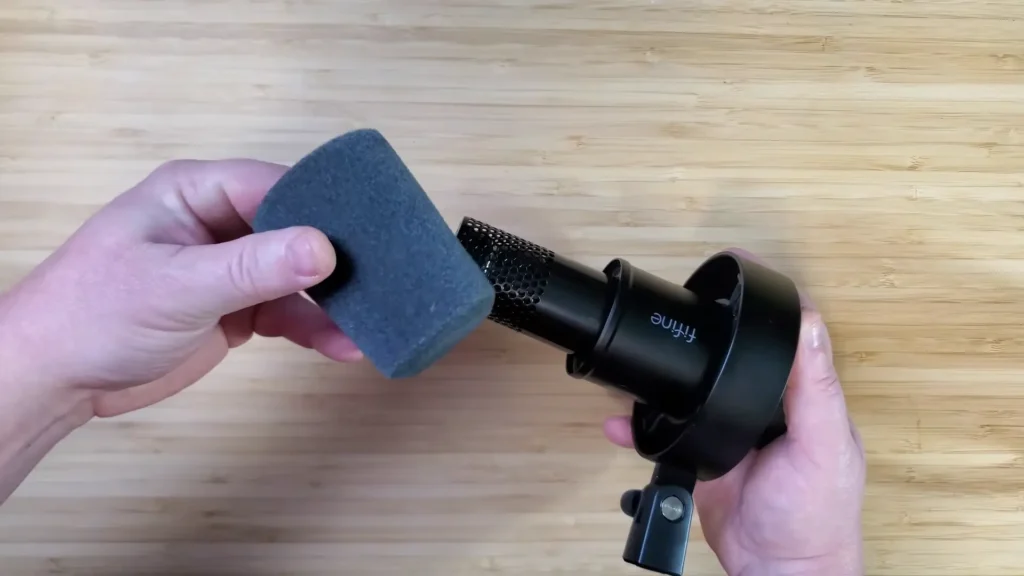
Here’s where the K688 shows its budget roots most clearly. The included windscreen has an unusual velvety texture that’s softer than expected but thinner than ideal. The result? Plosives (those harsh “P” and “B” sounds) can punch through more than you’d like.
The Capsule Problem
The SM7B’s legendary plosive resistance comes partly from its recessed capsule—there’s physical space between the grille and the diaphragm that acts as a natural buffer. The K688’s capsule sits much closer to the surface, offering less forgiveness for those who like to eat the mic.
Solutions That Work
Good news: the K688’s grille fits standard broadcast mic windscreens. Multiple reviewers confirmed that an SM7B foam windscreen or a Røde Podcaster windscreen fits this microphone perfectly and dramatically improves plosive rejection. Budget another $10-15 for this upgrade if plosives concern you.
Alternatively, positioning the microphone slightly off-axis (angled toward your mouth rather than pointing directly at it) and maintaining 4-6 inches of distance solves most plosive issues without additional gear.
Value for Money
Score: 9.0/10
Let’s talk numbers. The K688 retails for $72-83. A Shure SM7B runs around $400. The SE Electronics dynaCaster sits at roughly $300. Even the Shure MV7 (often considered a budget SM7B alternative) costs around $250.
In blind comparison tests, the K688 held its own against all of these. Not identical—let’s be clear about that—but close enough that your listeners won’t notice the difference. One reviewer put it bluntly: the K688 delivers “80-90% of the SM7B sound for about one-fifth the price.”
That’s what the side-by-side tests show. The SM7B remains smoother, particularly on harsh consonants, and offers that intangible “premium” feel. But for the price delta? The K688 represents extraordinary value.
How FIFINE K688 Compares to Others
vs. Shure SM7B ($400)
The SM7B remains the broadcast standard for good reason: smoother frequency response, better plosive handling, and decades of proven reliability. But it’s also gain-hungry (you’ll likely need a Cloudlifter or similar preamp boost) and costs five times as much. The K688 is the “good enough” option that’s actually good.
vs. Shure MV7 ($250)
The MV7 offers USB/XLR flexibility like the K688, with Shure’s polish and companion software for tone shaping. At three times the price, it should sound better—and it does, marginally. Whether that margin justifies the cost depends entirely on your budget and priorities.
vs. SE Electronics dynaCaster ($300)
The dynaCaster brings onboard EQ controls (low rolloff, high shelf) that the K688 lacks. For users who want hardware tone shaping without software, it’s worth the premium. For everyone else, the K688’s cleaner approach plus post-production EQ achieves similar results.
vs. FIFINE K658 ($72-80)
This is an easy call: get the K688. Same price range, but the K688 adds XLR connectivity, improves the knob design, and refines the overall package. Unless you find the K658 at a significant discount, there’s no reason to choose the older model.
vs. Samson Q9U ($120)
The Q9U offers a mid-boost mode and slightly higher USB resolution (24-bit). It’s a solid competitor at a higher price point. The choice here depends on whether those features matter to your workflow—for most users, the K688’s lower price wins.
Who Should Buy the FIFINE K688?
| User Type | Why It Works |
| Beginner Podcasters | Simple USB setup, professional sound without the learning curve, budget-friendly entry point |
| Streamers | Built-in mute button, low background noise pickup, works seamlessly with OBS and streaming software |
| Content Creators | Versatile USB/XLR options grow with your channel; clear voice quality for voiceovers |
| Remote Workers | Elevates video call audio quality; compact desk footprint; plug-and-play convenience |
| Budget Upgraders | Significant step up from webcam mics and cheap condensers without breaking the bank |
| Future-Proofers | XLR option means you can build a more sophisticated setup later without replacing your mic |
Who Should Look Elsewhere
If you need maximum control and proven reliability, you should stick with established options like the SM7B or Electro-Voice RE20. If you’re a singer or a vocal artist, condenser mics will provide a detailed and extended frequency response. For anyone who absolutely must have 24-bit USB resolution, the Samson Q9U or FDUCE SL40 will be a better choice.
Final Thought
Looking at the FIFINE K688 review, there is something genuinely rare: it delivers professional-grade audio quality at an entry-level price without feeling like a compromise. It’s the microphone many reviewers wish they’d had when starting, instead of wrestling with the Blue Yeti’s pickup patterns or suffering through cheap condenser noise floors.
It’s not perfect enough. The lightweight build, 16-bit USB limitation, and thin windscreen remind you that you’re not holding a $400 microphone. But for the overwhelming majority of content creators, streamers, and podcasters, those limitations won’t matter.
So, if you want broadcast-quality sound without broadcast-quality prices, the FIFINE K688 mic is a good choice. At this price point, the risk is minimal, and the reward is substantial.
FAQs
Does the FIFINE K688 need phantom power?
No. The K688 is a dynamic microphone that works without phantom power. It functions via USB (powered by your computer/device) or XLR (powered by your interface’s preamp).
Can I use the K688 with my phone or iPad?
Usually, FIFINE K688 would work better on a PC. When it comes to using on mobile, the effect might not be as same as good. But you can still have a try. Just check the K688 helper center to learn about it.
Is the shock mount removable?
No. The shock mount is permanently attached to the microphone body. This simplifies setup but means you can’t swap it for a different mount style.
How does it compare to the Blue Yeti?
The K688 is a dynamic microphone, while the Blue Yeti is a condenser—fundamentally different designs. The K688 rejects more background noise and requires a closer microphone technique, making it better suited for untreated rooms. Many reviewers consider it a significant upgrade from the Yeti for voice recording.
Should I use USB or XLR?
Start with a USB for simplicity. If you later want more control over your signal chain, the ability to use outboard processing, or to integrate with a multi-microphone setup, transition to XLR. The beauty of the K688 is that you don’t have to choose up front.
Does FIFINE offer good customer support?
This is an area where budget brands often struggle. Some reviewers noted that FIFINE’s troubleshooting resources (FAQ pages, technical support contacts) could be more comprehensive. For straightforward use cases, this likely won’t matter. For edge cases or defective units, your experience may vary.
