
Maximum SPL Explained: How Much Sound Pressure Your Mic Can Handle

You set up a mic in front of a snare, hit record, and play it back. The transients sound gritty. You drop the gain, try again, and the crunch is still there. It’s not the fault of the gain. Sometimes the sound itself is simply too loud for the mic. That’s where maximum SPL comes in.
In this guide, we’ll explain what sound pressure level is and how decibels describe it. Then we’ll define maximum SPL and show how it affects your microphone performance.
What Is SPL?
SPL stands for sound pressure level. It’s the most common way to describe how loud a sound is at a specific point in space, like the spot where your microphone sits.
What Is Sound Pressure?
Sound is a vibration that travels through air. A guitar string or a vocal cord pushes air molecules together, then pulls them apart. Those tiny squeezes and releases create small swings above and below the normal atmospheric pressure around us. That swing is sound pressure.
A sound wave carries two components: pressure and particle velocity. Pressure is much easier to capture than velocity. Your ears respond to pressure too, and so does a microphone diaphragm.
Sound pressure also tracks acoustic energy. In a simple free-field setup, sound intensity rises with the square of the pressure. Double the pressure, and you get roughly four times the acoustic intensity. That’s why a small-looking pressure jump can hit a microphone much harder than you’d expect.
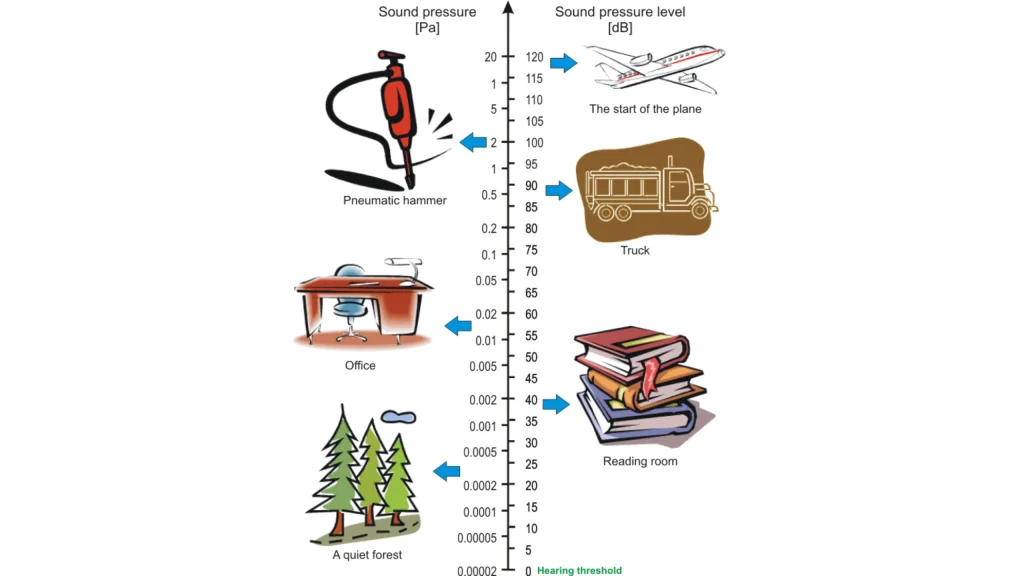
The international unit for pressure is pascals (Pa). Human hearing spans a huge range, from about 20 micropascals at the quietest to around 20 pascals at the loudest. That’s a range of one million to one.
What Does dB SPL Mean?
Here’s how the pieces fit together:
- Decibel (dB): A logarithmic unit that compares one value to a reference value. It’s a ratio, not a fixed amount.
- Sound Pressure Level (SPL): The decibel scale applied to sound pressure.
- Reference sound pressure: 20 micropascals, which sits roughly at the threshold of human hearing. That reference equals 0 dB SPL.
So 0 dB SPL doesn’t mean silence. It means “about as quiet as a person with healthy hearing can detect.”
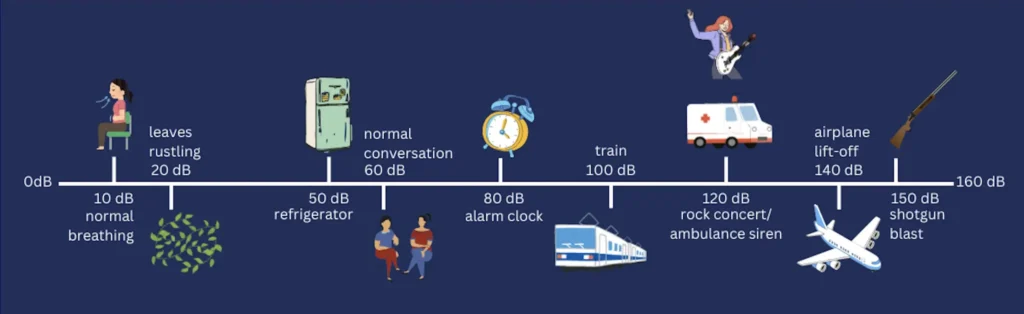
There’s an easy, manageable range: 0 to 120 dB SPL. It also comes with a few handy rules of thumb:
- +6 dB roughly doubles the sound pressure.
- +20 dB multiplies the sound pressure by 10.
- 94 dB SPL equals about 1 Pa, a common calibration level for microphones.
Because “decibel” shows up everywhere in audio (dBFS, dBu, dBV), always check for the “SPL” label. It tells you the number describes acoustic pressure in the air, not a signal level inside your gear.
How is SPL showcased in Daily Life?
| Sound Source | Approximate SPL |
|---|---|
| Quiet room or quiet studio | 30–40 dB SPL |
| Normal conversation | Around 60 dB SPL |
| Loud music or a live concert | Around 90–100 dB SPL |
| Very loud sound source | 110 dB SPL and above |
Around 120 dB SPL, most people reach the threshold of pain. That line is personal, though. Some listeners feel discomfort closer to 110 dB SPL, while others tolerate a bit more.
What Is Maximum SPL?
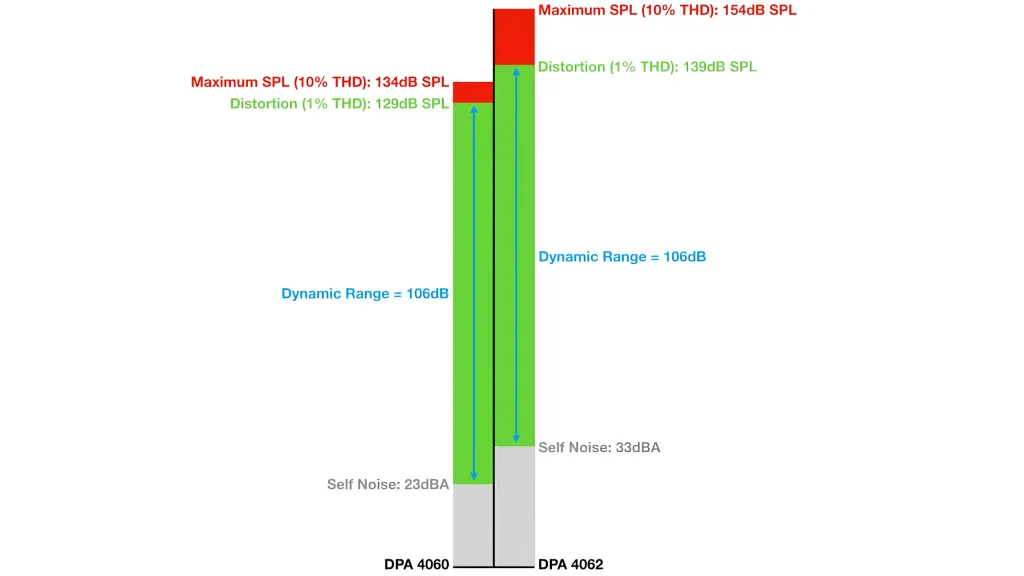
Maximum SPL is the highest sound pressure level a microphone is specified to handle under a particular test condition.
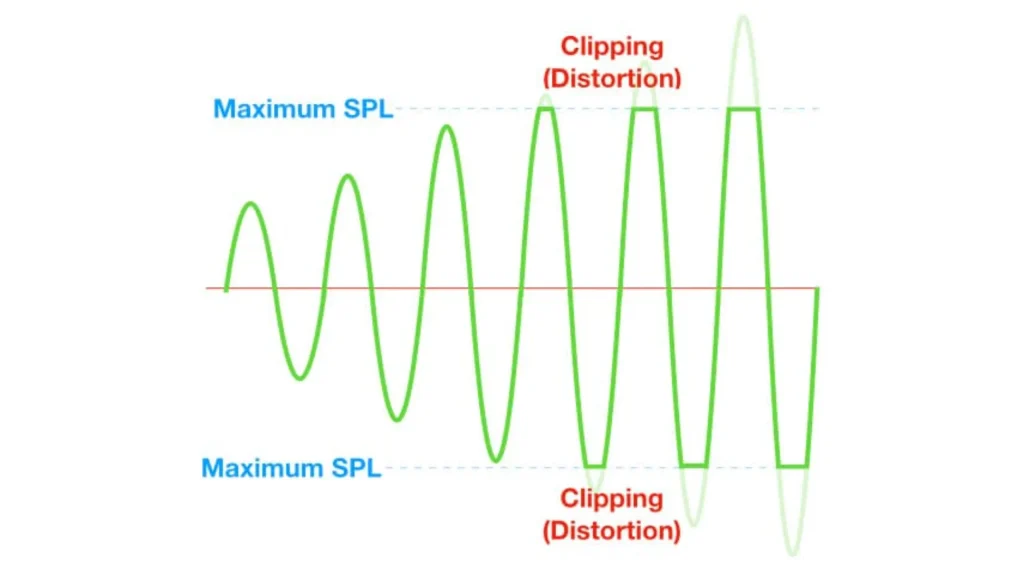
It’s the point where the microphone’s output starts to stop matching the sound going in. Push past it, and the mic begins adding distortion the original source never had.
Why Do Microphones Have an SPL Limit?
A microphone is a chain of parts, and every link has a ceiling:
- Mechanical limits of the capsule: A diaphragm can only move so far. At extreme pressure, it may hit its physical travel limits or stop moving in proportion to the sound.
- Electrical circuit limits: Circuits run on a fixed supply voltage. A signal that tries to swing past that voltage gets clipped.
- Internal preamplifier limits: Condenser mics and many USB mics have built-in electronics. Those stages usually overload before the capsule does, which makes them the most common cause of distortion.
- Nonlinear behavior at high levels: Even before hard clipping, parts of the system can start responding unevenly, which adds harmonic distortion.
Is Maximum SPL a Hard Physical Limit?
Not really. It helps to separate four ideas:
- Manufacturer’s specification: The number printed on the spec sheet.
- Measured operating condition: The exact test setup behind that number.
- Actual physical failure threshold: The level that could damage the mic.
- Performance degradation before damage: The zone where the mic still works but sounds worse.
The key point: A microphone may begin to show degraded performance before reaching a point of permanent physical damage. Hitting a mic slightly above its rated max SPL usually won’t break it. You’ll just hear more microphone distortion.
How Is Maximum SPL in a Microphone Measured?
Two mics can both claim “130 dB SPL” and still behave differently. The test conditions explain why. Look for these details:
- Frequency: Most brands test at 1 kHz. A mic may handle a different level at low or high frequencies.
- Distortion threshold: The amount of distortion allowed before the brand calls it the limit.
- Measurement distance or acoustic setup: Where the sound source sits and how the test room behaves.
- Microphone operating mode: Pad on or off, polar pattern, or any built-in switches.
- Power supply: Phantom power voltage can affect how much headroom a condenser’s electronics have.
- Preamplifier or internal electronics: Whether the test covers the capsule alone or the full signal path.
Usually, the max SPL is a calculated value, not a direct acoustic measurement. Some manufacturers take a different route to get a clean SPL tone. They feed an electrical test signal into the mic’s electronics, find the level where distortion crosses the threshold, and then convert that level into an equivalent dB SPL figure using the mic’s sensitivity. That’s why specs from different brands don’t always line up.
Why Does the Distortion Threshold Matter?
Maximum SPL is often measured at a specific THD level, such as 0.5%, 1%, or 3%. A higher THD threshold produces a higher SPL rating, but not necessarily better performance. For example, a mic rated at 135 dB SPL at 3% THD may not outperform one rated at 130 dB SPL at 0.5% THD—the latter simply uses a stricter measurement standard.
How Does Microphone Type Affect Maximum SPL?
Not all microphones handle loud sounds the same way. But is it simply about condenser vs. dynamic microphones? Not quite. Let’s break it down.
Dynamic Microphones
Traditional passive dynamic mics don’t require built-in active electronics, so their maximum SPL is generally limited by the capsule’s mechanical design rather than an internal preamp.
That’s why many dynamic mics handle loud sources well. However, not all dynamic mics are built the same way. The fifine Tank3 Dynamic Microphone, for example, has a maximum SPL rating of 120 dB. For USB/XLR dynamic mics, internal electronics can also affect the maximum SPL.
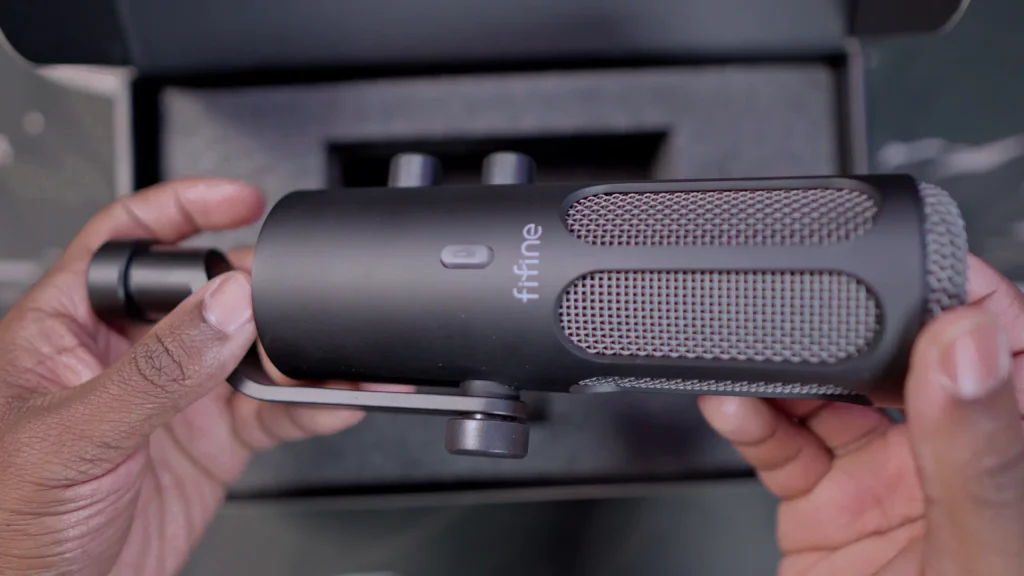
The takeaway? Maximum SPL depends on the overall microphone design.
Condenser Microphones
Condenser mics use a sensitive capsule and internal electronics, which often determine their maximum SPL.
For example:
- fifine A6V microphone: 110 dB SPL
- fifine T669 microphone kit: 130 dB SPL (at 1 kHz, ≤1% THD)
Both are USB condenser microphones, yet their listed maximum SPL ratings differ significantly.
Many condensers also include a -10 dB or -20 dB attenuation pad, allowing them to handle louder sources before distortion. Always check whether the max SPL rating applies with the pad enabled.
USB Microphones
A USB mic combines several components in one device:
- Capsule: Converts sound into an electrical signal.
- Preamp: Boosts the signal.
- ADC: Converts the signal into digital data and can clip at 0 dBFS.
- DSP: May add compression, limiting, or EQ.
Any of these components can affect how a USB mic handles loud sounds.
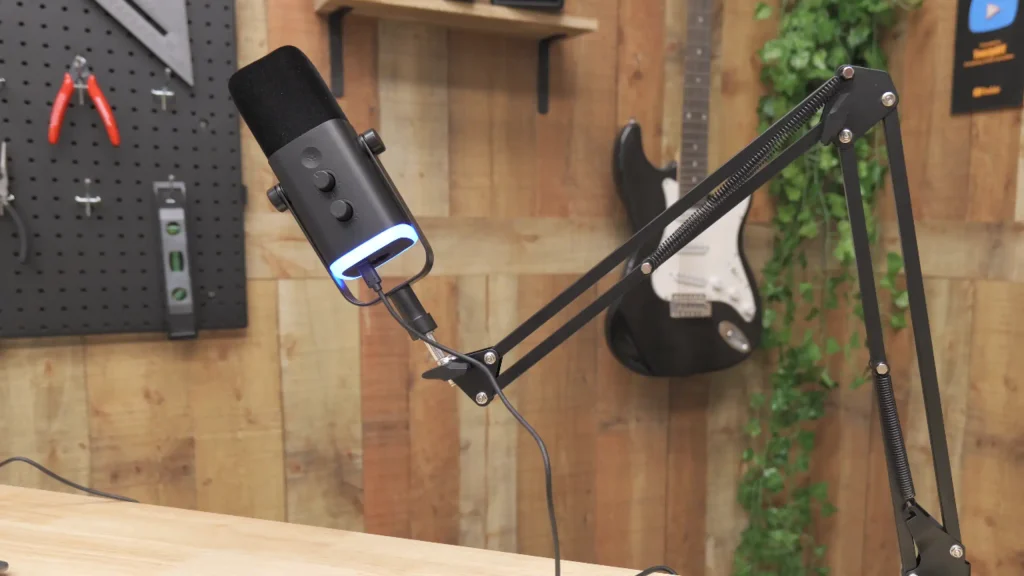
For example, the fifine AmpliGame AM8T, a USB/XLR dynamic microphone kit, has a maximum SPL of 120 dB. This highlights how a microphone’s overall design—not just its capsule type—affects its SPL handling.
Maximum SPL vs. Sensitivity
Maximum SPL and sensitivity answer different questions:
| Parameter | Main Question |
|---|---|
| Sensitivity | How much electrical output does the microphone produce for a given sound pressure? |
| Max SPL | How much sound pressure can the microphone handle within its specified performance limit? |
Sensitivity describes how “hot” the mic’s output is at a standard level, usually 94 dB SPL. Max SPL describes the ceiling. One doesn’t automatically determine the other.
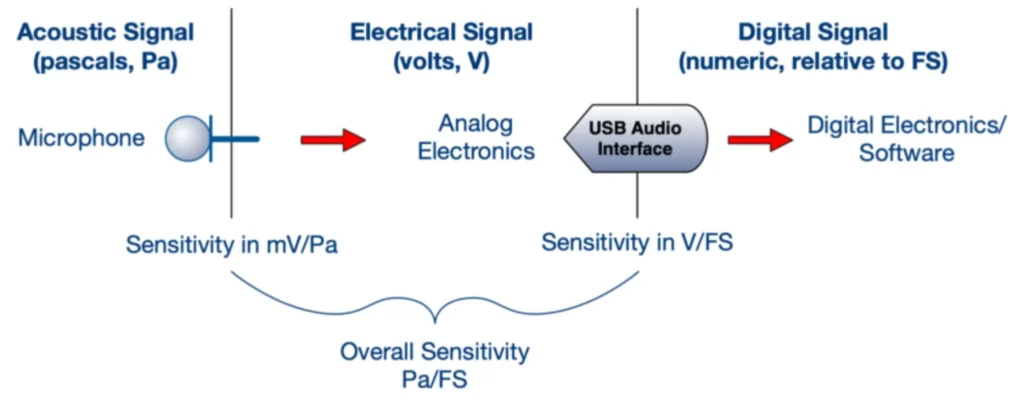
A highly sensitive condenser might still handle loud sources well if its electronics have plenty of headroom. A low-sensitivity mic isn’t guaranteed to have a high max SPL either.
Want to go deeper? Read our guides on What Is Microphone Sensitivity?
How to Read a Max SPL Specification
Here’s a typical spec line:
Maximum SPL: 130 dB SPL at 1% THD, 1kHz
| Specification Element | Meaning |
|---|---|
| 130 dB SPL | Reported maximum sound pressure level |
| 1% THD | Distortion threshold used for the measurement |
| 1kHz | Test frequency |
| Missing test details | May limit direct comparison |
When comparing mics, line up the THD threshold and test frequency first. If one sheet leaves those out, treat the comparison as rough. And if a mic has a pad, look for a separate rating with the pad engaged.
How Much Maximum SPL Do You Need?
| Application | Typical SPL at the mic | What to watch |
|---|---|---|
| Spoken voice | Roughly 70–85 dB SPL at normal distance | Rarely an issue, even for loud talkers. |
| Singing | Roughly 90–110 dB SPL close-miked | Belted notes at two inches run much hotter. |
| Acoustic guitar | Roughly 90–100 dB SPL close-miked | Hard strumming adds sharp transients. |
| Drums | Snare hits top 150 dB SPL; a loud kick runs 140–150 dB SPL | The most demanding common source. |
| Guitar amplifier | Often 120–130 dB SPL at the grille of a cranked cab | A few inches back drops the level fast. |
| Field recording | About 30 dB SPL to 120 dB SPL and up | Levels can jump 40 dB in a second. |
Shure’s engineering team measured a maximum of 135 dB SPL from the human voice at one inch, and found a loud kick drum can pass 140 dB SPL but never hit 150 dB SPL in their tests. DPA reports higher figures still for snare hits and trumpet peaks. Remember that charts like this list averages: DPA notes that peaks can sit about 20 dB above the average level, or 10 times the pressure. Your mic distorts on the peaks.
Your microphone placement and distance matter, too. Before you decide whether a mic can handle a job, think about where it will sit. For a point source in open space, the level drops about 6 dB each time you double the distance.
Conclusion
Microphone maximum SPL tells you how much sound pressure a microphone can take before distortion creeps in. It’s measured under specific conditions, so the THD threshold, test frequency, and operating mode all shape the final number.
For voice and streaming, almost any decent mic will do. For drums, amps, and brass, max SPL moves to the top of your checklist. Factor in mic distance, use a pad when you need one, and remember that clipping can also start in your interface.
FAQs
What is a good max SPL for a microphone?
It depends on what you record. For speech and streaming, most mics offer plenty of headroom. For close-miked drums, loud amps, or brass, look for a higher rating and check the test conditions behind it.
Can loud sounds damage my microphone?
Exceeding the rated max SPL usually causes distortion first, not permanent damage. Extreme pressure or physical impact can still harm a capsule, so avoid pushing any mic far beyond its spec.
Why doesn’t my dynamic mic list a max SPL?
Many dynamic mics have no internal electronics to overload, and their capsules handle very high levels. Some manufacturers skip the spec because typical recording situations rarely reach the mic’s limit.
Is there a limit to how loud a sound can get?
In air at normal atmospheric pressure, an undistorted sound wave tops out around 194 dB SPL. Past that point, the low-pressure half of the wave can’t drop below zero pressure, so the wave itself distorts.
How do I know if distortion comes from the mic or my interface?
Lower your interface gain. If the distortion vanishes, your interface input was clipping. If it remains, the mic is likely overloading, so move it back or engage a pad.
