

Headphone Drivers 101: Types, Sizes, and How They Affect Sound

A headphone driver is the small component that turns an electrical signal into the sound you hear — the speaker inside your headphones. Different headphones use different driver types and sizes.
Hold onto this before we start: a bigger or more advanced driver does not automatically mean better sound. In this guide, we’re going to walk through everything about headphone drivers and what actually shapes the sound you hear.
What Is a Headphone Driver?
A headphone driver is the speaker inside your headphones. Engineers call it an acoustic transducer, which is a fancy way of saying it converts electrical energy into sound energy. It moves air, and moving air is sound.
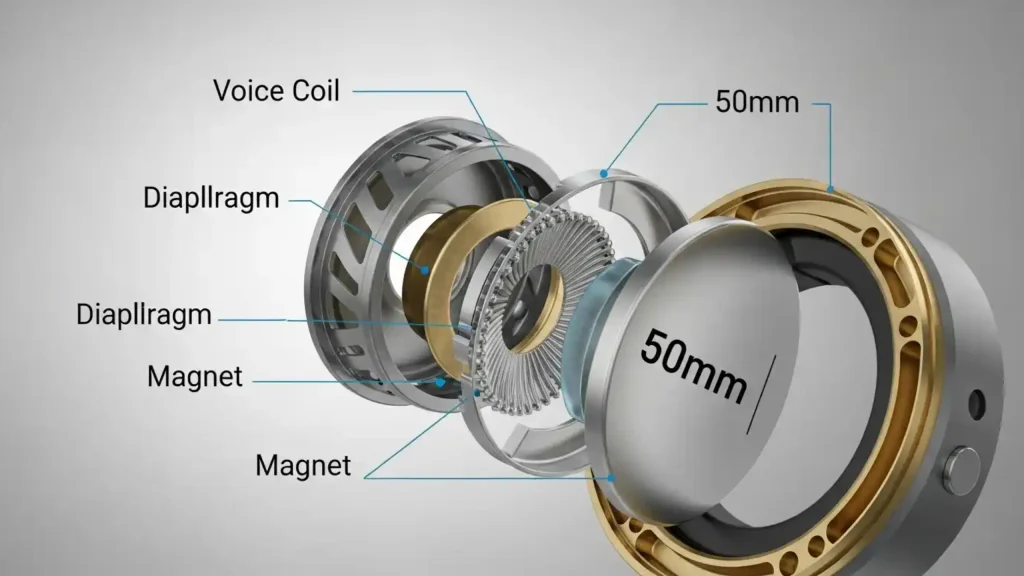
Most drivers rely on three core parts:
- A diaphragm — the surface that pushes the air
- A magnet — usually permanent, providing a fixed magnetic field
- A voice coil (or another driving mechanism) — the part that reacts to your audio signal and makes the diaphragm move
How does a headphone driver work:
Electrical signal → driver movement → diaphragm movement → air movement → sound
Your amplifier sends a current through the driver. That current creates a magnetic field, which pushes and pulls against the permanent magnet. That push-pull moves the diaphragm back and forth. The diaphragm shoves the air, the air vibrates, and your ears read those vibrations as sound.
Feed the driver a slow, lazy wave and it moves slowly — you hear low bass. Feed it a fast, tight wave and it flutters quickly — you hear high treble. The speed and size of the diaphragm’s movement are what create different frequencies.
4 Main Types of Headphone Drivers
Four technologies dominate the market: dynamic, planar magnetic, electrostatic, and balanced armature. Let’s take them one at a time.
#1. Dynamic Drivers
Dynamic drivers — also called moving-coil drivers — are the most common type by a wide margin. If you own a pair of headphones right now, odds are they’re dynamic.
The dynamic driver is the classic speaker design you’ll find everywhere from earbuds to subwoofers: a diaphragm shaped like a rigid cone or dome, a voice coil attached to its back, and a permanent magnet (often neodymium) around or inside the coil.
Send current through the coil and it becomes an electromagnet. That electromagnetic force pushes and pulls against the permanent magnet, dragging the diaphragm with it. More air moves, more sound comes out.
Advantages:
- Strong bass potential — a large, rigid diaphragm moves a lot of air, which is why you’ll rarely see a subwoofer using anything else
- Efficient — they don’t demand much power
- Durable — they hold up unless you actively poke at them
- Versatile — they scale from cheap earbuds to flagship headphones
Disadvantages:
- Performance leans heavily on design and tuning; the driver type alone guarantees nothing
- The diaphragm-and-coil assembly is relatively heavy, which can make it harder to move fast for the very highest frequencies
- They can show more harmonic distortion than some rivals, especially at high volume
Where they’re used: basically everywhere — fifine gaming headsets, consumer headphones, studio monitors, and plenty of IEMs.
#2. Planar Magnetic Drivers
When you start spending more, planar magnetic drivers (sometimes called orthodynamic) show up. They’re prized for accuracy and detail.
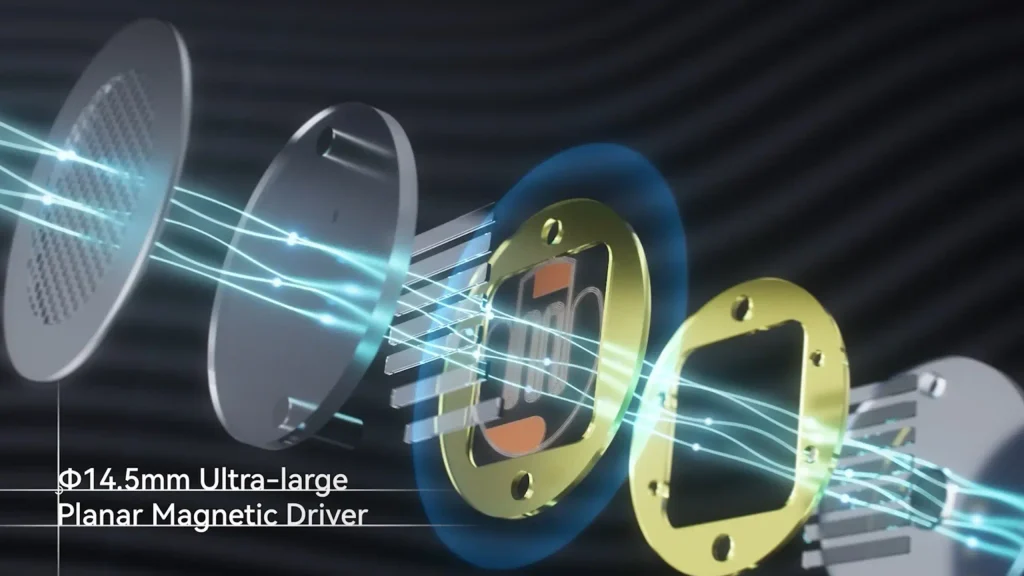
How planar magnetic drivers work. Instead of a rigid cone, a planar driver uses an ultra-thin, tensioned sheet as its diaphragm. Instead of a voice coil, thin conductive traces are printed or etched onto that sheet, and the whole thing sits inside an array of magnets.
Pass current through the traces and they generate an electromagnetic field that interacts with the magnets, pushing and pulling the diaphragm. The force spreads evenly across the entire surface. So the whole diaphragm moves together instead of being driven from one central point.
Advantages:
- Fast response, thanks to the low mass of that thin sheet
- Low distortion potential
- Excellent detail and instrument separation
- Strong bass extension — planars often reach cleanly down to 20Hz, where open-back dynamics sometimes roll off in the sub-bass
Disadvantages:
- Usually larger and heavier
- Often more expensive
- Can demand more power to drive properly
- Tricky and costly to manufacture consistently
Planar magnetic vs. dynamic drivers
| Feature | Dynamic | Planar Magnetic |
|---|---|---|
| Construction | Voice coil + cone diaphragm | Traces on a thin sheet between magnets |
| Weight | Often lighter | Often heavier |
| Efficiency | Usually easy to drive | May need more power |
| Bass | Punchy, big slam | Deep, tight, well-extended |
| Detail | Good | Excellent separation |
| Distortion | Can rise at volume | Low potential |
| Price | Budget to flagship | Usually pricier |
Planars tend to sound tighter, faster, and more surgical — great for busy, layered tracks where you want every instrument in its own space. Dynamics tend to deliver more visceral punch and slam, plus a presentation many listeners find more natural.
#3. Electrostatic Drivers
Electrostatic drivers are the exotic option. You’ll only meet them in flagship, no-compromise headphones. Here’s the twist: they use electrostatic force—the same effect that makes a balloon rubbed on your sweater pull your hair upward.
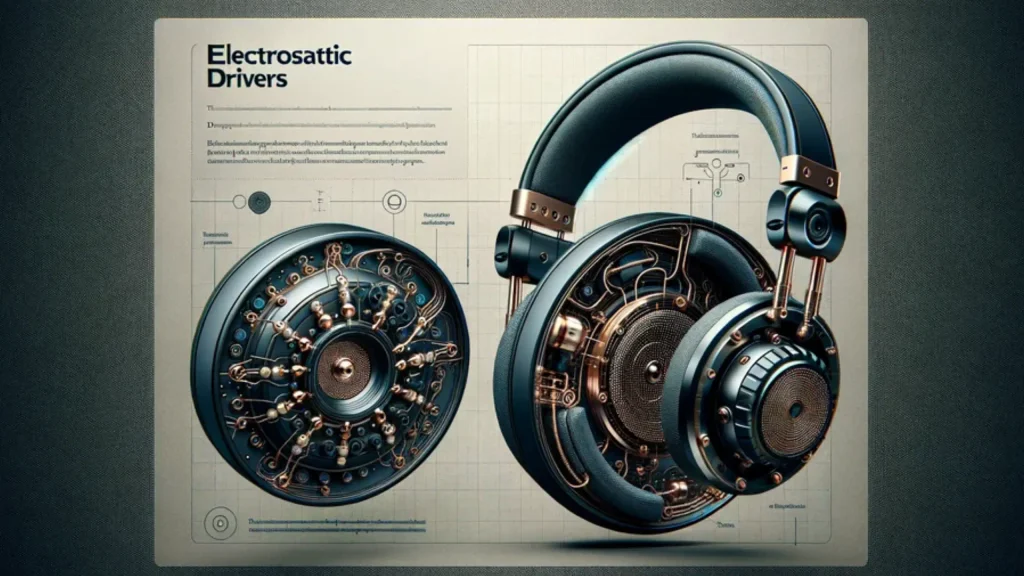
An ultra-thin diaphragm, coated with a charge-holding film, sits sandwiched between two metal grids called stators. A fixed bias voltage keeps the diaphragm statically charged. The audio signal goes to the stators: as it swings positive and negative, one stator attracts the diaphragm while the other repels it, moving it back and forth to make sound.
Advantages:
- Very low distortion potential
- Extremely fast response, because the diaphragm is almost impossibly light
- A high level of detail, clear highs, and a wide soundstage
Disadvantages:
- Expensive to produce
- Require a dedicated amplifier called an energizer — a normal amp won’t run them
- Sensitive to dust, moisture, and humidity
- Rare in mainstream headphones
Who they’re for: audiophiles and high-end listeners chasing the last few percent of realism. Brands like STAX are famous for them.
#4. Balanced Armature Drivers
Balanced armature (BA) drivers go the opposite direction: tiny and built almost exclusively for in-ear monitors.
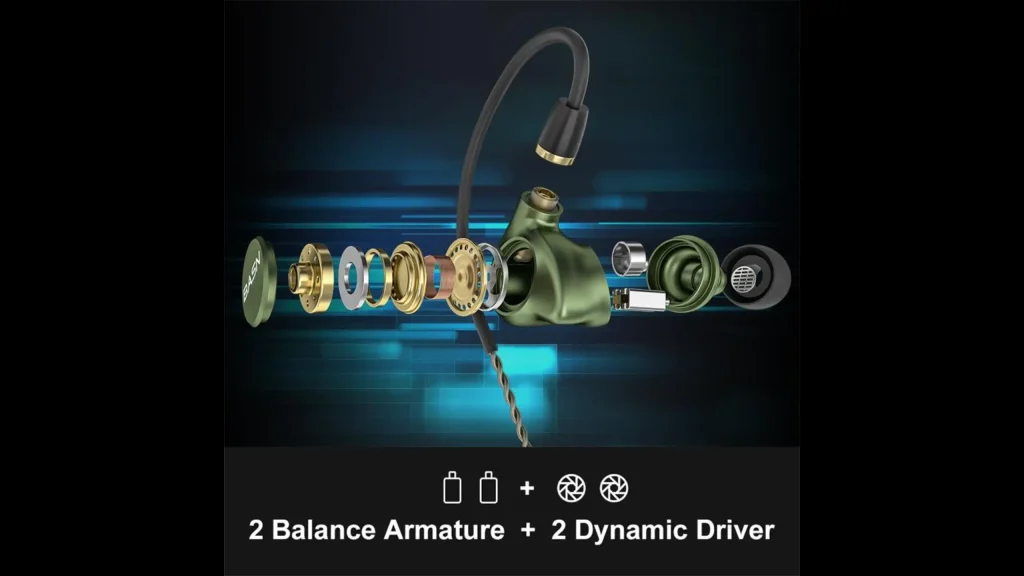
A BA driver looks like a little metal box. Inside sits a stationary coil, a pair of permanent magnets, and a small U-shaped armature balanced between them, with a rod linking it to a diaphragm.
At rest, the armature sits in a neutral, “balanced” position. Feed current to the coil and the armature magnetizes, gets pulled toward one magnet, and nudges the diaphragm through that rod. Only the armature moves — the coil and magnets stay put.
Advantages:
- Extremely compact
- Good high-frequency detail
- Highly efficient (which is why hearing aids rely on them for battery life)
- Small enough to pack several into one earphone for multi-driver designs
Disadvantages:
- A single BA usually can’t produce strong, full bass on its own
- Often needs to be paired with other drivers to cover the full range
Where they’re used: in-ear monitors, hearing-related devices, and multi-driver earphones where several BAs split the work — one set for bass, another for mids, another for treble.
Bonus: Hybrid Driver
A typical hybrid IEM uses a dynamic driver for low frequencies and one or more BA drivers for mids and highs. You get the dynamic’s punchy low end and the BA’s detailed top, tuned together.
The catch: blending driver types cleanly is hard, and a poorly tuned hybrid can sound disjointed.
Which Driver Type Fits You?
Now that you know how each one works, here’s the quick version of who each driver suits:
| Driver type | Choose it if you… |
|---|---|
| Dynamic | Want a versatile all-rounder with strong bass and good value — ideal for gaming and multimedia |
| Planar magnetic | Prioritize detail and fast response, and will pay a premium for a high-end listen |
| Electrostatic | Are an enthusiast chasing top-end realism and don’t mind extra gear |
| Balanced armature/hybrid | Want compact IEMs with a multi-driver design and strong detail |
Headphone Driver Size: The Bigger, The Better?
Driver size is just the diameter of the diaphragm, measured in millimeters. For over-ear headphones, you’ll most often see 40mm, 45mm, and 50mm. Drop down to earphones and earbuds and the numbers shrink to roughly 10mm, 11mm, and 12mm.
Size is not the same as technology. You can have a 40mm dynamic driver in fifine H9 headsets, a 50mm dynamic driver in fifine H13 gaming headset, and a 50mm planar magnetic driver — and all three will sound completely different despite the numbers.
Does Driver Size Affect Sound?
It can, up to a point. A larger diaphragm can move more air, which may help with bass output, overall air movement and dynamics, and a bigger, more spacious presentation.
But the headphone driver size alone can’t predict sound quality. A bigger driver also has more surface area that can flex unevenly and distort, especially at high volume. Bigger tends to mean louder, not automatically cleaner.
40mm vs. 50mm Drivers
The 40mm-versus-50mm driver size comes up constantly, especially with gaming headset drivers. Here’s a level-headed comparison:
| Feature | 40mm | 50mm |
|---|---|---|
| Bass potential | Good | Potentially stronger |
| Immersion | Good | Potentially stronger |
| Weight | Often lighter | Often heavier |
| Gaming | Depends on tuning | Depends on tuning |
| Sound quality | Depends on design | Depends on design |
Bigger headphone driver sizes don’t mean better sound. What actually decides the result is driver material, driver construction, tuning, earcup design, frequency response, and DSP. A 50mm driver in a poorly designed earcup with sloppy tuning will lose to a 40mm driver someone actually engineered with care.

What Actually Determines Headphone Sound Quality?
If the driver spec isn’t the answer, what is? Sound quality comes from the entire acoustic system working together. Here’s where the real differences live:
- Driver materials. Lighter diaphragms start and stop faster for cleaner highs; stiffer ones resist unwanted flexing. The wrong balance adds resonance that muddies the sound.
- Tuning. Arguably the biggest factor of all. Neutral tuning chases accuracy; V-shaped tuning boosts bass and treble for a more exciting sound. Two headphones with identical drivers can sound like different products purely because of tuning.
- Magnet and voice coil design. Stronger magnets and well-designed coils give the driver more control and efficiency, so it moves precisely and handles power without straining.
- Acoustic chamber and earcup design. Open-back sounds more spacious but leaks; closed-back isolates you and reinforces bass — which is why planars, needing a tight front-volume seal, are hard to build well as closed-backs.
- DSP and software. Built-in EQ, virtual surround, and spatial audio can reshape the sound entirely — a core selling point in gaming headsets.
Which Headphone Driver Is Best for Gaming?
Gaming is where driver questions get most heated, so let’s get practical. Two driver types cover almost every gaming headset:
| Dynamic | Planar Magnetic | |
|---|---|---|
| Bass | Strong, physical impact | Tight, well-extended |
| Power needs | Runs off a console or motherboard | May need more power |
| Detail | Good | Sharp, precise cues |
| Price | Budget to mid-range | Premium |
| Best for | Most players | Clarity-focused players |
Dynamic drivers dominate for good reason: strong bass, enough efficiency to run without a separate amp, and versatile tuning. You’ll see how fifine gaming headsets like fifine H13 or fifine H9 are the sensible pick. Planar magnetic headsets sit at the premium end, where fast response and low distortion turn into cleaner, easier-to-place audio — if you’re willing to pay for it.
But driver type is rarely the deciding factor. These matter more:
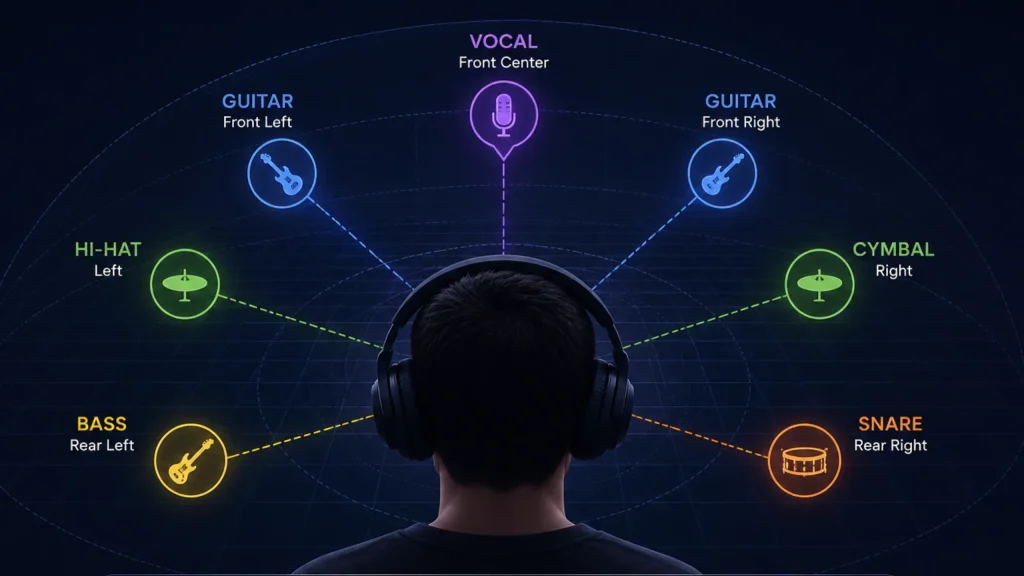
- Imaging and soundstage — can you tell where a sound is coming from?
- Footstep clarity — is the detail you need actually audible?
- Comfort — you’re wearing these for hours
- Microphone quality — your teammates have to hear you too
A headset with a modest driver but excellent imaging will beat a spec-sheet monster that smears everything together.
Conclusion: What Should You Look for in a Headphone Driver?
There’s no single best type of driver. Every headphone driver type carries pros and cons, and most of them depend on how the whole product is designed.
A 50mm badge or a “planar magnetic” label isn’t a guarantee of anything, especially in headsets for gaming. Figure out what you actually need — bass and immersion, or clarity and precision — then look for a well-tuned product that delivers it. The driver is where sound begins. It’s just not where sound ends.
FAQs
Does driver size really matter in headphones?
Not on its own. A bigger driver can move more air and often plays louder, but tuning, materials, and acoustic design affect sound quality far more.
Are 50mm drivers better than 40mm drivers?
Not automatically. 50mm drivers have more bass and immersion potential, but the actual result depends on tuning and earcup design. Plenty of excellent headphones use 40mm drivers.
What’s the best driver type for gaming?
Dynamic drivers are the practical choice for most gamers — strong bass, good efficiency, and versatile tuning. But imaging, soundstage, and comfort matter more than the driver type itself.
What driver types or driver sizes can I get in fifine gaming headsets?
fifine gaming headsets use dynamic drivers in 40mm, 50mm, and 53mm sizes. For example, the fifine H9 40mm gaming headset, the H13 50mm gaming headset, and the H19 53mm open-back headset. Choose the size that best fits your gaming and listening needs.
