
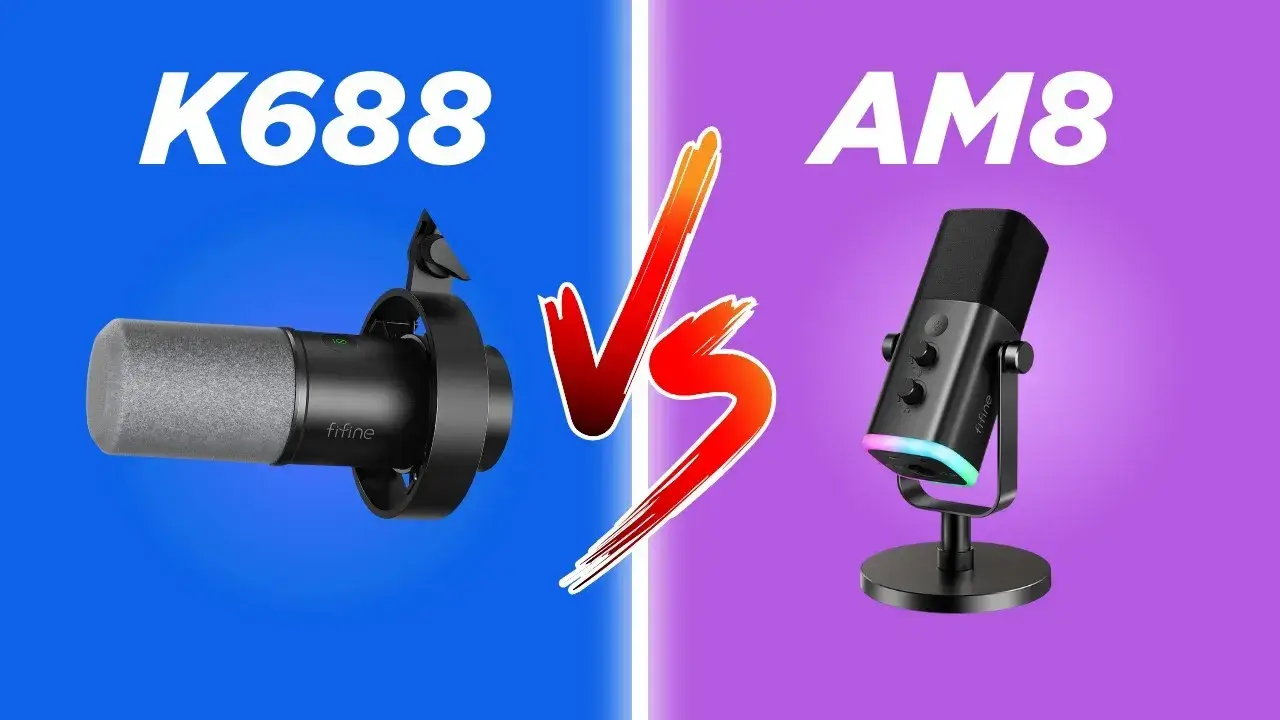
FIFINE AM8 vs. K688: Which Dynamic Microphone Deserves Your Desk?

The FIFINE AM8 and K688 are two of the most popular budget dynamic microphones right now. Both offer USB and XLR connectivity, tap-to-mute, headphone monitoring, and come in black, white, or pink. On paper, they look almost identical. In practice? They sound and perform quite differently.
What is best for FIFINE AM8 vs. K688? It’s hard to pick one. After analyzing extensive testing data across 15 different categories—from plosive rejection to guitar recording—we can say that the AM8 claims the overall crown. But don’t write off the K688 just yet. We’re breaking down every measurement, every test, and every real-world scenario so you can figure out which mic actually belongs on your desk.
Head-to-Head Comparison
| FIFINE AM8 | FIFINE K688 |
|---|---|
| Price: ~$59 | Price: ~$70–$79 |
| Frequency Response: 50Hz–16kHz | Frequency Response: 50Hz–15kHz |
| Sensitivity: -50dB | Sensitivity: -58dB |
| Max SPL: 120dB | Max SPL: 130dB |
| Signal-to-Noise: >80dB | Signal-to-Noise: >80dB |
| Weight: 395g (mic only) | Weight: 318g (with shock mount) |
| Connectivity: USB-C + XLR | Connectivity: USB-C + XLR |
| Includes: Tabletop stand, pop filter | Includes: Shock mount, pop filter |
| RGB Lighting: Yes (toggleable) | RGB Lighting: No |
| Overall Score: 9/17 rounds | Overall Score: 5/17 rounds |
| ★ OVERALL WINNER | ★ BEST FOR PODCASTING |
AM8 vs. K688: Measurements
1. Frequency Response
The FIFINE AM8 microphone captures frequencies from 50Hz all the way up to 16kHz. The K688 operates within a tighter 50Hz–15kHz range. In practical terms? The AM8 picks up more bass rumble and more high-frequency detail. That extended top end gives voices a shimmer—some describe it as almost artificial, but most find it pleasant and present.
The K688’s narrower range isn’t a weakness—it’s a design choice. By rolling off those extreme lows and highs, it naturally filters out some room noise and harsh frequencies. If you’ve got a voice that’s already bright or mid-heavy, the K688 won’t amplify that further. It protects listeners from fatigue during long-form content.
Winner: AM8 for versatility, K688 for convenience. If you plan to record instruments or want maximum flexibility for post-production EQ work, the AM8’s wider range gives you more to work with. If you want plug-and-play simplicity with a naturally smooth sound, the K688 delivers.
2. Sensitivity
The AM8’s sensitivity sits at -50dB; the K688 comes in at -58dB. That 8dB difference matters more than you’d think. Higher sensitivity (the AM8) means the microphone responds more eagerly to sound waves—you’ll get a hotter signal with less gain required. But it also means plosives hit harder. Those explosive “P” and “B” sounds create bigger spikes in your audio waveform.
The K688’s lower sensitivity acts as a built-in buffer. It’s more forgiving when someone leans into the mic or gets enthusiastic during a gaming session. Testing confirmed this: the K688 handled plosive tests more gracefully, even when speakers deliberately attacked it with aggressive consonants.
Which is best: K688 for plosive rejection, AM8 for cleaner gain structure?
3. Maximum Sound Pressure Level (Max SPL)
The FIFINE K688 USB/XLR microphone handles up to 130dB before distortion kicks in. The AM8 tops out at 120dB. For most voice recordings, neither limit will ever become an issue—normal speech sits around 60–70dB. But if you’re recording loud vocalists, energetic streamers who yell during gameplay, or instruments like guitar amps and drums, that 10dB headroom difference provides real peace of mind.
Winner: K688. More headroom means less worry about clipping during loud moments.
4. Signal-to-Noise Ratio
The AM8 boasts a signal-to-noise ratio greater than 80dB; the K688 comes in at greater than 75dB. Higher numbers are better here—they indicate how much usable signal you get compared to the microphone’s self-noise. That 5dB advantage means the AM8 can amplify quiet sounds (like soft-spoken ASMR-style content or distant instrument recordings) with less hiss and noise floor creeping into your tracks.
Winner: AM8. You can get a cleaner signal, especially at higher gain levels.
5. Weight and Build
The AM8 (microphone body alone) weighs 395g. With its included stand, the complete package hits 580g. The K688 with its shock mount weighs just 318g. If you’re mounting these on a boom arm or adjustable stand, that weight difference affects balance and positioning. Lighter microphones are easier to position and put less stress on budget boom arms.
Winner: K688. Lighter weight means better compatibility with budget mounting solutions.
6. Connectivity and Features
Both microphones offer USB-C and XLR outputs, tap-to-mute buttons, and headphone monitoring jacks. The AM8 adds RGB lighting (toggleable by holding the touch button) and comes with a complete tabletop stand. The K688 includes a shock mount and has buttons hidden on the bottom rather than visible on the sides—a cleaner look that mimics the Shure SM7B aesthetic many content creators chase.
Available colors for both: black, white, and pink. The K688’s appearance has fooled many viewers into thinking it’s an SM7B or similar broadcast microphone.
Winner: AM8 for included accessories, K688 for aesthetics.
Detailed Test for FIFINE AM8 vs. K688
1. Clarity
The AM8 won this round decisively. Its extended high-frequency response gives voices an almost condenser-like quality—crisp, detailed, and present. One reviewer described it as having “life at the top.” That clarity helps vocals cut through background music or game audio in mixed content.
Winner: AM8
2. Background Noise Rejection
Testing against AC units and gaming laptop fans revealed a close contest. Both microphones rejected similar amounts of ambient noise from their intended pickup pattern. However, the AM8’s extended frequency response captured slightly more high-frequency “airy” noise that the K688’s rolled-off top end naturally filtered out.
Winner: K688 (marginally). The narrower frequency range works in its favor here.
3. Proximity Effect
Getting close to any dynamic microphone boosts bass frequencies—that’s the proximity effect. The AM8 handles this beautifully. You can get right up on it, add warmth and presence to your voice, and maintain clarity. No muddy, muffled quality.
On the other hand, the K688 at extreme close distances sounded “like speaking into a pillow”—stepping back just slightly restored clarity, but you lose that intimate bass boost.
Winner: AM8. Better for close-miking techniques.
4. USB Mode Performance
Here’s where things get interesting. Both microphones have internal preamps and digital converters for USB operation. The AM8’s internal processing sounds cleaner and more polished. The K688 in USB mode exhibits a noticeable resonance that one reviewer likened to “a seven-seater SUV using a sedan’s engine”—not underpowered, but not reaching its full potential. The K688 truly shines when connected via XLR to a quality external preamp.
What makes things more interesting is that both support simultaneous USB and XLR recording, which opens up interesting backup recording possibilities.
Winner: AM8. Better internal preamp implementation.
5. XLR Mode Performance
Connected to external preamps and audio interfaces, both mics perform excellently. This was declared a draw in testing—no complaints about either mic’s XLR output quality. They represent tremendous value for XLR microphones at their price points.
Winner: Draw. It depends on you.
6. Headphone Output
Testing with Audio-Technica ATH-M40x headphones (low impedance), the AM8 powered them adequately—reaching comfortable monitoring levels without maxing out. The K688 fell slightly short; reviewers wished for just a bit more volume. Not unusable, but not quite in the “Goldilocks zone.”
Winner: AM8
7. Vocal Recording
For singing and vocal performance, the AM8’s extended upper frequencies help voices cut through mixes. That high-end “shimmer” might sound slightly artificial to some ears, but it’s generally more pleasant than the K688’s darker tone for vocal applications. The K688 sounds more like a traditional broadcast dynamic—warm and smooth, but potentially lost in dense arrangements.
Winner: AM8. The voice will be more natural and pleasant.
8. Instrument Recording (Guitar)
Here, the K688 stages a comeback. The AM8’s sensitivity and signal-to-noise ratio should produce cleaner tracks, and it did capture nice high-frequency sparkle. But testers found the K688’s warmer, fuller-bodied reproduction more pleasing for acoustic guitar. The K688’s natural mid-range emphasis complements string instruments beautifully.
Winner: K688. It sounds warmer and fuller-bodied.
9. Price
At approximately $59, the AM8 undercuts the K688’s $70–$79 typical price point by a meaningful margin. Given that the AM8 also includes a complete tabletop stand while the K688 comes with a shock mount (requiring a separate stand or boom arm), the value proposition tilts further toward the AM8.
Winner: AM8, the budget-friendly choice.
Our Testing Process
We pulled data from multiple independent reviewers who put both mics through 15 rounds of real-world testing—everything from plosive rejection and background noise to vocal recording and guitar tone.
The setup? Both mics ran through a Rodecaster Duo with identical settings: same gain, same XLR cables, processing off. For USB tests, we plugged straight into recording software to see how those built-in preamps actually hold up.
To keep things practical, testers threw real-world curveballs at these mics: AC units blasting on high, gaming laptops in turbo mode, and the classic “Peter Piper” tongue-twister to hammer those plosives.
One critical note: These tests used the updated versions of both microphones. FIFINE quietly revised the AM8 and K688—recessing the capsules about 3/4 inch and beefing up the pop filters. The difference in plosive handling is night and day.
Conclusion: FIFINE AM8 vs K688?
With 7 out of 15 test rounds compared to the K688’s 4 wins (with 4 draws), the FIFINE AM8 wins overall. It’s the more versatile microphone—better for USB-only users, stronger headphone output, wider frequency capture for vocals, multiple use cases, and a lower price that includes ready-to-use accessories.
But the K688 wins for specific users:
- Podcasters: The smoother, darker tone prevents listener fatigue over long episodes.
- Streamers with bright voices: The K688 tames harsh high frequencies naturally.
- XLR users with quality preamps: The K688’s full potential unlocks with external processing.
- Acoustic instrument recording: Warmer, fuller guitar tone.
- Aesthetics-focused creators: That SM7B look without the $440 price tag.
Both mics punch way above their weight. For under $80, you get XLR + USB connectivity, headphone monitoring, tap-to-mute, and sound quality rivaling mics costing 3–4x more. Find a reviewer with a voice similar to yours, listen carefully, and trust your ears.
FAQs
Can I use both USB and XLR simultaneously?
Yes. Both the AM8 and K688 support recording through USB and XLR at the same time. This is useful for creating backup recordings or routing audio to multiple destinations.
Do I need an audio interface?
No. Both microphones work perfectly fine via USB without any additional equipment. However, the K688 particularly benefits from a quality external preamp when used in XLR mode—its internal USB preamp doesn’t quite do the capsule justice. The AM8’s USB performance is strong enough that many users will never need to invest in an interface.
Can I turn off the RGB lighting on the AM8?
Yes. Press and hold the touch button for a few seconds to disable RGB. Hold again to re-enable. The K688 has no RGB lighting.
Which microphone sounds more like the Shure SM7B?
Both offer SM7B-adjacent tones at a fraction of the price (the SM7B currently runs around $440). The AM8 captures more of the SM7B’s versatility and tonal range. The K688 better mimics the SM7B’s smooth broadcast character and visual aesthetic. Neither is a perfect clone, but for under $80, both get remarkably close.
Do I need a boom arm?
The AM8 includes a complete tabletop stand, so you can start recording immediately. The K688 comes with a shock mount but requires a separate boom arm or mic stand. If desk space is limited or you want the microphone closer to your mouth during recording, a boom arm improves both microphones’ usability—and the K688’s lighter weight makes it easier to balance on budget arms.
