
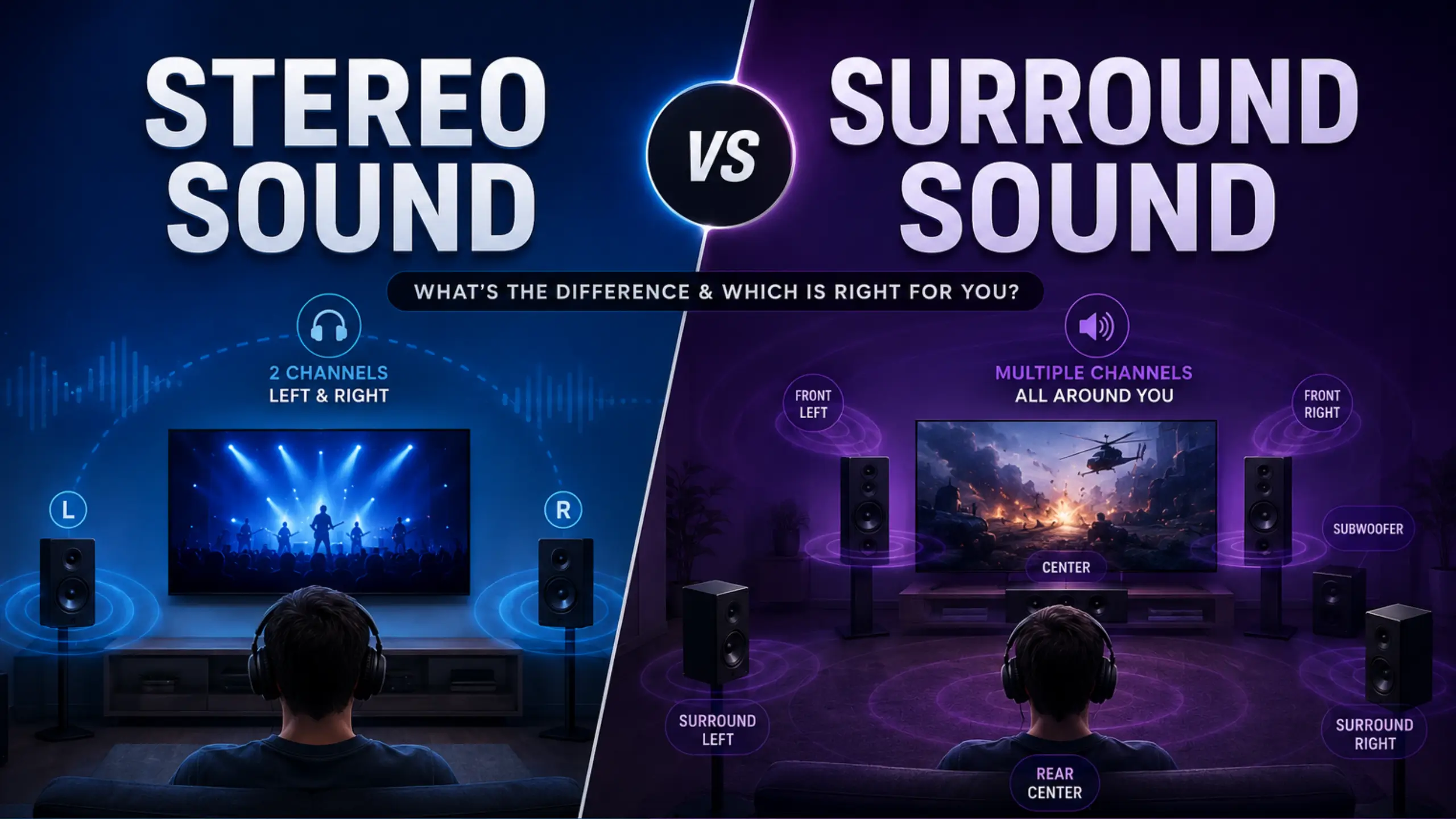
Stereo Sound vs Surround Sound: Which Helps You Game Better?

If you’ve shopped for your first audio system or a new gaming headset, you’ve seen “stereo” and “surround” tossed around like they’re interchangeable. They aren’t. Put simply, stereo is built for accuracy and music, surround is built for immersion and movies.
They decide how you hear, immersion or restoration. So, stereo sound vs surround sound? Whether you’re picking a headset or a video system, we’ll break down both concepts and compare them across the dimensions that actually matter. Finally, let’s see which one is ideal for your real-world scenarios.
Quick Comparison Table
| Dimension | Stereo Sound | Surround Sound |
|---|---|---|
| Audio Channels | Left + Right | Virtual or multi-channel spatial simulation |
| Core Strength | Precise positioning | Immersive environment |
| Best For | Competitive FPS games | Cinematic and open-world games |
| Positional Accuracy | Cleaner and more direct | Can feel wider but sometimes less precise |
| Audio Processing | Minimal | DSP / virtual processing |
| Footstep Clarity | Usually stronger | Can become overprocessed |
| Immersion | Moderate | High |
| Common Usage | CS2, VALORANT, esports | RPGs, story games, movies |
What Is Stereo Sound?
Stereo audio carries two channels: a left channel and a right channel. That’s the headline difference from mono sound, which uses a single channel that plays the same signal out of every speaker, no matter how many you have.
Through two speakers, you get a phantom image — the sound seems to float between them, not come from one speaker or the other. Adjust the left-right blend (called panning), and a sound can sit anywhere across that span. That’s the magic of a stereo image. You’ll feel like the singer’s in front of you.
How to Reach The Best Stereo Sound
Your brain pulls this off using two location cues. Interaural level difference (ILD): A sound on your left is louder in your left ear. Interaural time difference (ITD): A sound from the left reaches your left ear a fraction earlier. ITDs are so powerful that even when both speakers are equally loud, the ear that hears the sound first wins — a quirk known as the Haas effect. That’s what the better image is to set your speakers and your seat in an equilateral triangle.

Stereo Sound Key Features
Two channels, panning and stereo imaging, and a 2.0 or 2.1 layout — the optional “.1” being a subwoofer. Stereo is sensitive to placement, so it rewards a proper equilateral-triangle setup, and it works just as readily through a pair of headphones as through speakers.
Pros
- Accurate footsteps
- Cleaner directional cues
- Preferred by many esports players
- Less audio clutter
- Works well across most games
Cons
- Less cinematic immersion
- Smaller environmental feel
- Less dramatic spatial effects
What Is Surround Sound?
Surround sound uses multiple channels placed in key spots around the room to produce audio you feel from all directions. The shorthand numbers tell you exactly what’s in the system. The first number is the count of main channels — front left, front right, center, and the rears. The second number is the subwoofers. The third number, when present, is height or upward-firing speakers that put sound above you.
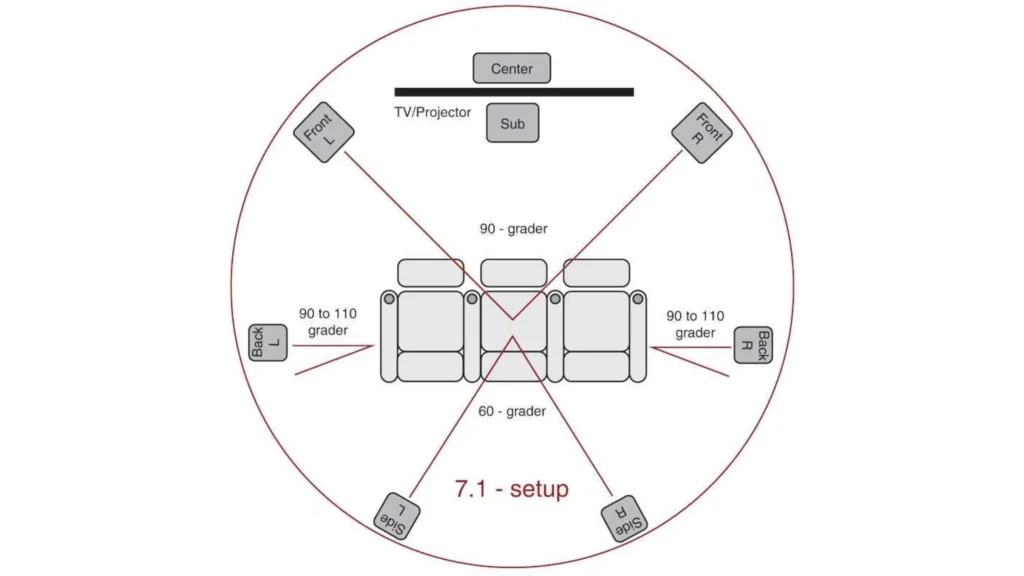
Surround Sound Types
| Configuration | What It Adds | What You Get |
|---|---|---|
| 2.0 | Left and right speakers | Plain stereo, no subwoofer |
| 2.1 | A subwoofer | Stereo with reinforced low end |
| 3.1 | A center channel | Noticeably sharper dialogue |
| 5.1 | Rear left and rear right | The first true surround sound from behind you |
| 7.1 | Side speakers | Fuller envelopment, common in dedicated home theaters |
| 9.1.2 | Height plus extra front speakers | Overhead effects and a wider front stage |
Those height speakers are the cinematic flourish. But height only works when the content supports Dolby Atmos or DTS:X. On the format side, seven-channel systems run on Dolby Digital Plus (compressed) and Dolby TrueHD (uncompressed), or DTS-HD (compressed) and DTS-HD Master Audio (uncompressed).
Surround Sound Key Features
Multiple channel configurations, a dialogue-focused center channel, a subwoofer for low-end punch, and optional height speakers for overhead effects. Crucially, surround leans on the right audio format — without Dolby Atmos or DTS:X content, those extra channels don’t work.
Pros
- More immersive gameplay
- Strong environmental scale
- Better cinematic experience
- Enhanced atmosphere in story games
Cons
- Directional cues may feel less precise
- Audio can become overprocessed
- Footsteps may sound less natural
- Competitive consistency varies by implementation
Stereo Sound vs Surround Sound: Key Differences
1. Audio Positioning
Stereo places sound along a single horizontal line between your two speakers using level and timing cues. Surround spreads it across the full room — front, sides, rear, and even overhead with Atmos. One paints a precise picture in front of you; the other surrounds you with the whole scene.
Verdict: For pinpoint front imaging, stereo. For locating sound coming from every direction, surround.
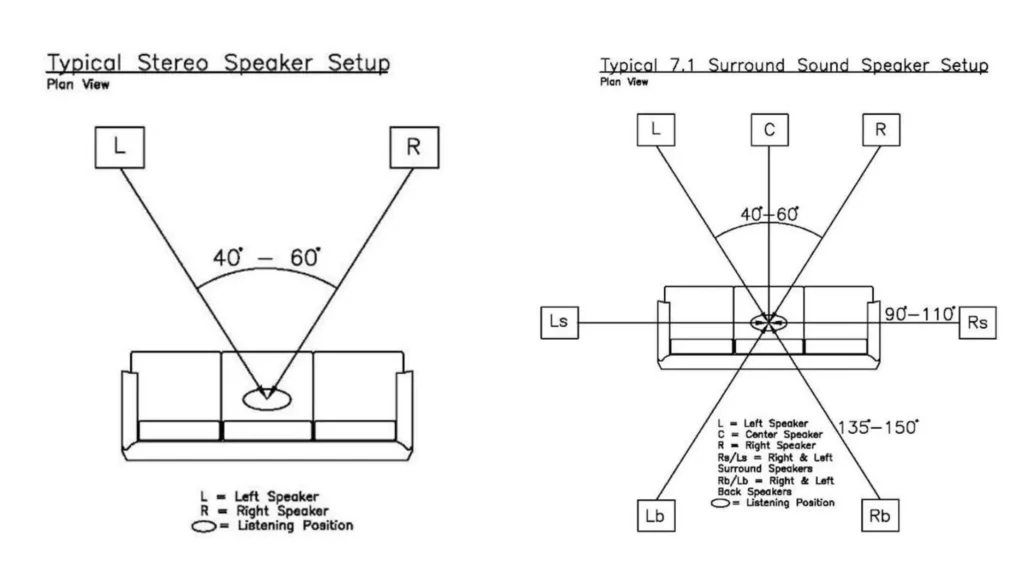
2. Music Listening Experience
Stereo was made for music. The vast majority of recordings are mixed in two channels, and a quality stereo system reproduces them with a presence that makes the performer feel close. Pile on rear and height channels, and you’re spreading a two-channel mix into spaces it was never meant for.
Verdict: For music, stereo — every time.
3. Gaming Performance
Most gaming headsets only have two channels — left and right — so a “7.1” label on a headset is processing, not seven physical drivers. Plenty of that processing is little more than an equalizer preset dressed up.
The good news: modern competitive titles like Overwatch, Call of Duty, and Apex Legends pack in enough audio design that a clean stereo signal already tells you where the footsteps are.
Where surround processing genuinely earns its place is through HRTF-based virtual surround. It estimates how sound waves would reach your ears and can add a real sense of space.
Verdict: For casual or competitive players who trust their ears, stereo is plenty. For players chasing extra positional cues or immersion, virtual surround helps.
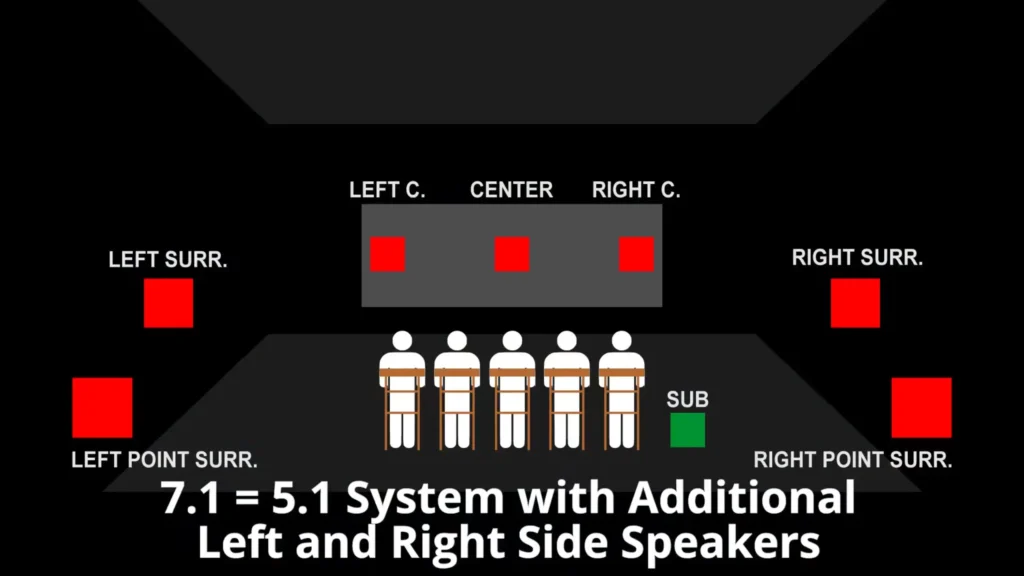
4. Movie and Streaming Experience
This is the Surrounds home turf. The center channel keeps dialogue crisp and locked to the screen, the rears fill in ambience, and Atmos height speakers sell the moment a plane roars overhead. Watch enough films and a 5.1 or 7.1 system transforms the experience in ways stereo can’t match.
Verdict: For movies and binge sessions, surround.
5. Sound Accuracy vs Immersion
Stereo prioritizes fidelity and a faithful, accurate soundstage. It wants you to hear the recording as it was made. Surround prioritizes envelopment. It wants you inside the scene, even if that means processing the original mix.
Verdict: Value accuracy and detail? Stereo. Value being surrounded by the action? Surround.
6. Setup and Compatibility
A stereo rig can be as lean as a source, an amplifier, and two speakers — or just a pair of headphones. The trade-off: you’re locked into 2.0 or 2.1 with no path to expand. Surround needs an AV receiver, more speakers, cable runs, and format support, but it scales.
A smart middle road: Start with a great pair of stereo speakers on an AV receiver, then add a center, rears, and a subwoofer over time for a full home-cinema effect.
Verdict: For simplicity, stereo. For a system you’ll grow into, pick surround sound with an AV receiver.
Stereo Sound vs Surround Sound: How to Pick
| Your Situation | Best Choice | Why |
|---|---|---|
| Roughly 80% music, 20% movies | Stereo | Music is mixed in two channels, and a focused stereo rig reproduces it with the presence audiophiles want |
| 80–90% movies, shows, and cinematic games | Surround | The center channel, rears, and height speakers put you inside the scene |
| Tight on space or budget, single room | Stereo | Fewer components, no cable runs, and an easy path to good sound |
| Split habits — daily living plus movie nights | Both | A simple stereo setup for everyday use, a surround system for the main event |
| Competitive gaming where you trust your ears | Stereo | Modern titles bury enough audio cues in two channels to locate footsteps |
| Immersive single-player or home-theater gaming | Surround / virtual 7.1 | Envelopment and extra positional cues raise the immersion |
Choose Stereo Sound If You: mostly listen to music and value accuracy over spectacle. Budget- and space-friendly, no rear or ceiling speakers to install.
Choose Surround Sound If You: spend your evenings on films, shows, and cinematic games. The center channel, rears, and Atmos height speakers deliver an immersive stereo that can’t be matched.
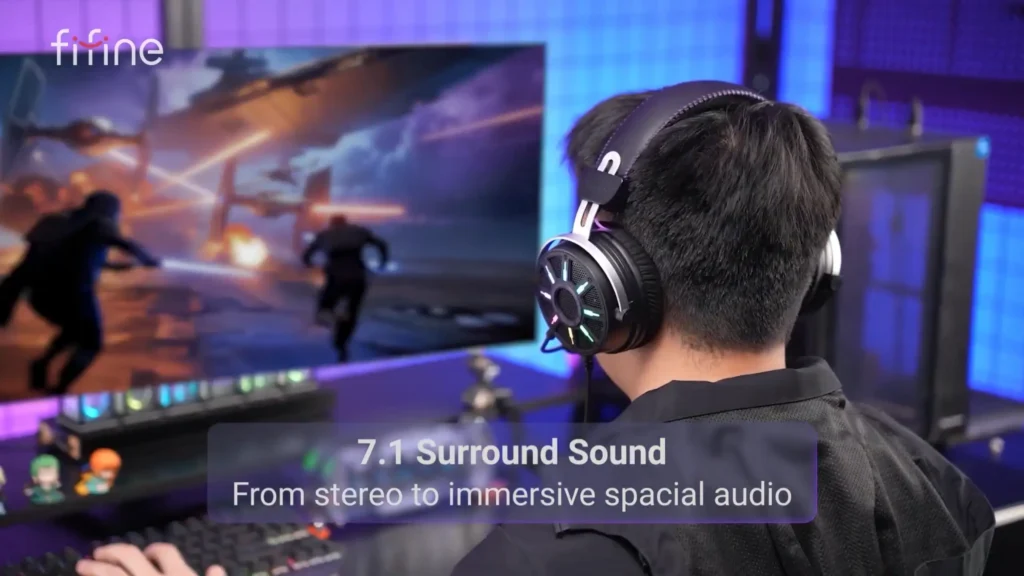
Consider Both If You: have split habits — a surround home theater for big movie nights and a simple stereo rig for everyday living-room use. Or start stereo on an AV receiver and add channels over time.
Stereo vs Surround Sound for Gaming Headsets
Headsets have just two drivers sitting against your ears. That’s worth understanding before you pay extra for a surround badge.
How Gaming Headsets Simulate Surround
Virtual surround is the trick that makes two drivers feel like many. It leans on HRTF — head-related transfer function — which calculates how the timing and position of sound waves would hit your ears, then bakes that into the signal so audio seems to come from specific points in space.
The model is based on a generic head and ear shape, so it isn’t perfect (and software is often weakest at telling above from below), but it’s good enough for most ears.
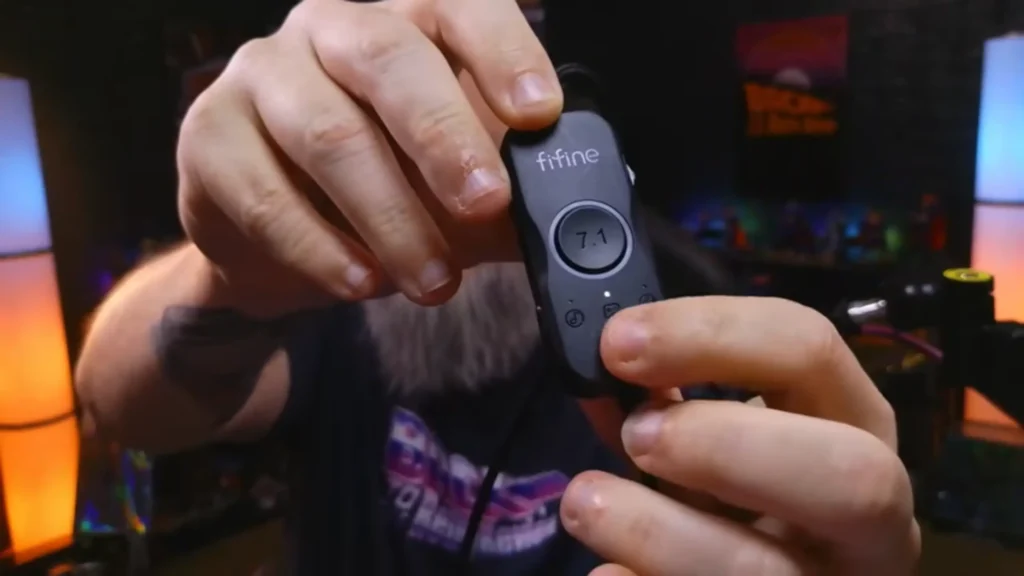
FIFINE Gaming Headsets with 7.1 Surround
| Model | Sound | Connection | Standout Features | Best For |
|---|---|---|---|---|
| FIFINE H3 | Stereo-first (budget pick) | 3.5mm with Y-splitter | 50mm dynamic drivers, 20Hz–20kHz, plug-and-go on most platforms | A multi-platform gamer who wants clean, accurate sound |
| FIFINE H6 | Virtual 7.1 surround | USB plug-and-play | 50mm drivers, RGB lighting, detachable noise-canceling mic, 3 EQ modes (game/music/movie) | PC & PlayStation players who want the simplest path to immersive audio |
| FIFINE H9 | Virtual 7.1 surround (over USB) | Dual USB + 3.5mm | Works with PC, PlayStation, Switch, and Xbox; Adapter cable control | A gamer who hops between consoles and wants surround sound with USB |
| FIFINE H19 | Virtual 7.1 surround | USB (open-back design) | 53mm drivers, open-back soundstage; airy separation without ear fatigue | Players who want open-back clarity and virtual surround for pinpointing enemies in FPS |
Who Should Choose a FIFINE 7.1 Surround Gaming Headset?
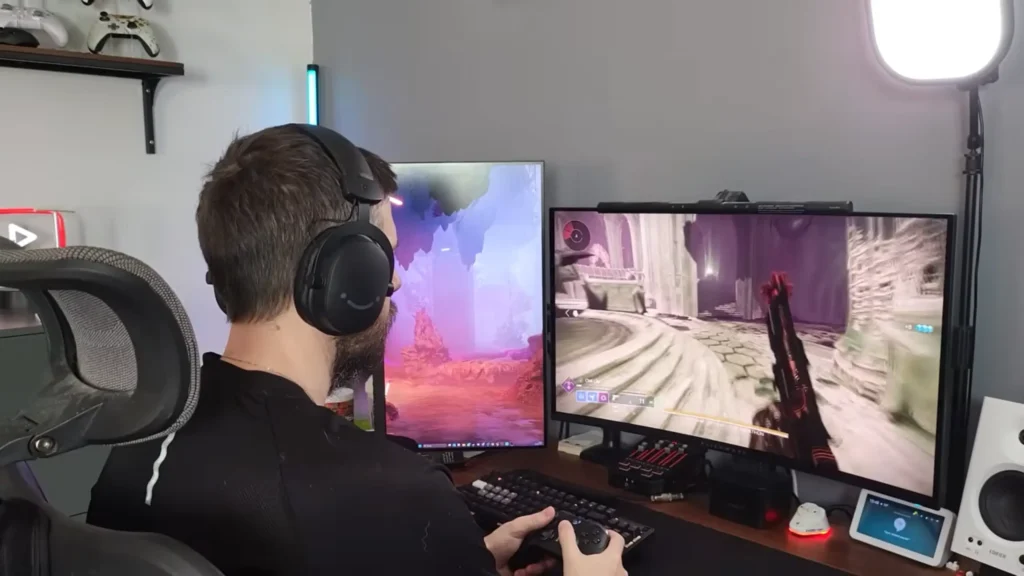
- FPS players who want sharper directional cues for footsteps and gunfire.
- Immersive RPG and open-world gamers who want to feel inside the world, not just hear it in front of them.
- Streamers who benefit from richer, more cinematic audio (and the flexible EQ and mic options that usually come with these headsets).
- Movie watchers who use the same headset for films and want that wraparound effect after the game ends.
Final Words
Stereo and surround aren’t rivals so much as different tools. Stereo gives you accuracy, a faithful front soundstage, and a simple, affordable setup. Surround gives you the immersion with channels around and above you.
There’s no winner for stereo sound vs surround sound. Just pick by how you listen. Music devotees and competitive players should lean towards stereo. Film fans and cinematic-game players should go surround. Whether you’re building a home studio or picking the best gaming headset, consider simplicity or immersion first.
FAQs
Is surround sound always better than stereo?
No. Surround is better for immersion in movies and cinematic games, but stereo is better for music and for accurate, front-focused listening. The right choice depends on your content, not on channel count.
Does 7.1 surround actually help in competitive games?
Sometimes. Modern competitive titles are designed so that a good stereo signal already reveals enemy positions. Virtual 7.1 built on HRTF can add useful positional cues and immersion, but it isn’t a guaranteed shortcut to climbing the ranks.
Are surround sound headsets good for streaming?
Yes. Surround sound headsets can enhance immersion and improve game audio awareness during streams, especially for FPS and cinematic gameplay content.
Can I get surround sound from regular stereo headphones?
Yes. HRTF-based software like Dolby Atmos, DTS Headphone:X, and Windows’ spatial sound can add a virtual surround effect to ordinary stereo headphones — a budget-friendly way to test the experience.
Do I need a subwoofer for a stereo setup?
Not necessarily. A 2.0 stereo system runs on two speakers alone. Adding a subwoofer makes it 2.1 and reinforces the low end, but with capable speakers, it’s often optional.
