
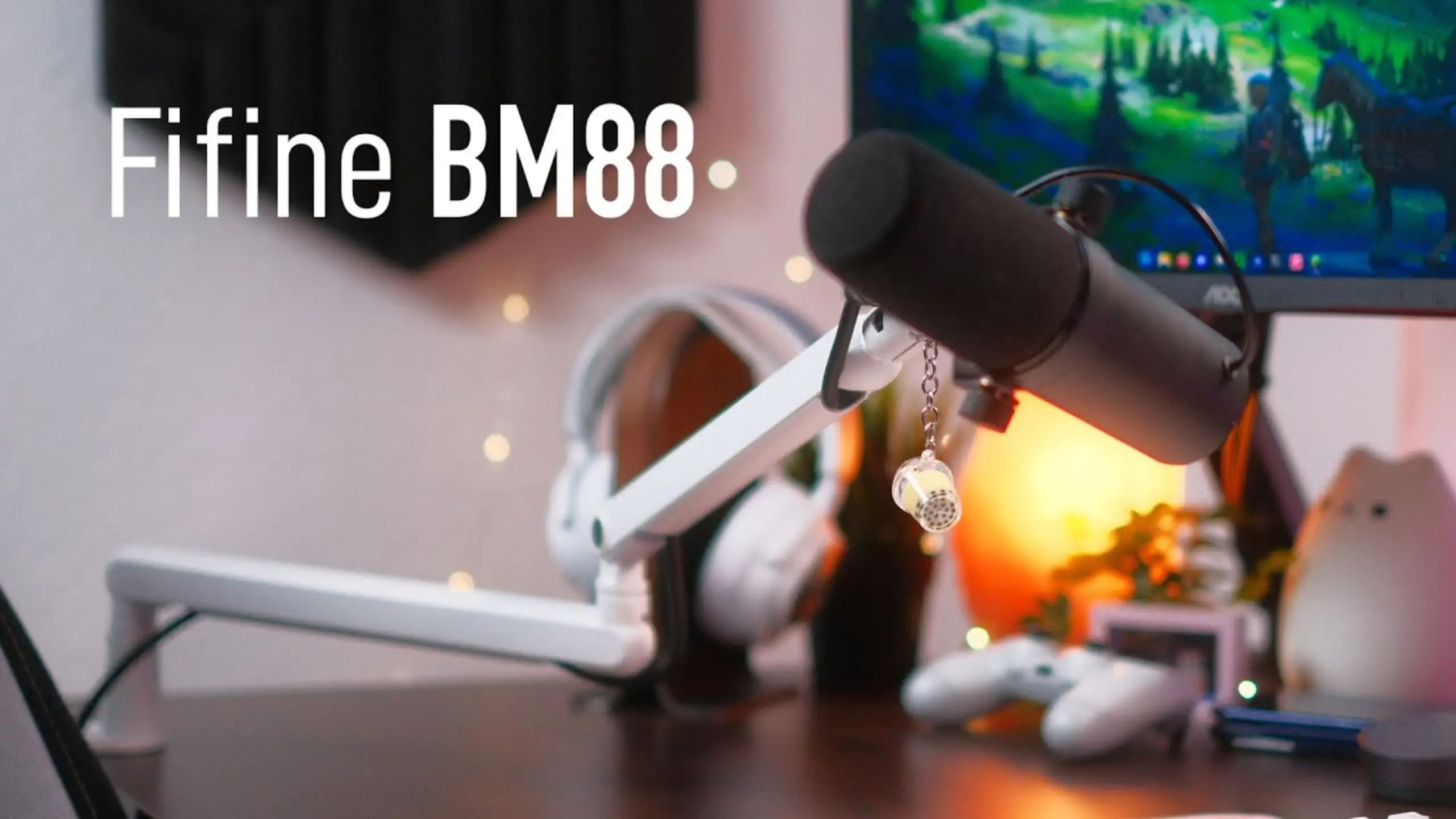
FIFINE BM88 Review: A Budget Boom Arm That Feels Super Premium

You may feel frustrated that your boom arm is always looming in shot when you’re running a livestream. A low-profile mic arm solves that problem by sitting below your camera’s sightline.
But does it actually deliver the build quality and flexibility, or will it sag after a week? After our test and exploration of the FIFINE BM88 review, we can confidently say the BM88 earns its spot on your desk. Here’s the full breakdown.
Quick Verdict on FIFINE BM88 Review
Overall Score: 8.5/10
Pros:
- All-metal construction at a budget-friendly price
- Minimal branding keeps the arm looking clean on camera
- Built-in cable management channels that actually stay in place
- Handles heavy mics like the Shure SM7B with ease (1.5 kg max payload)
- Versatile thread adapters (1/4″, 3/8″, 5/8″) work with mics and camera gear
- Available in black and white
Cons:
- The ball joint can’t reach a full 90° angle, limiting some mic orientations
- Allen wrench adjustments are less convenient than spring-loaded alternatives
- Long-term durability is unproven
Build Quality — 9/10
The BM88 is all metal. Pick it up, and you feel the weight immediately — this is not a hollow, plasticky arm trying to pass itself off as premium. The joints feel solid, the desk clamp inspires confidence, and the matte finish gives it a refined look without fingerprint smudges.
The clamp includes rubber dampening pads on both contact surfaces, so it grips your desk firmly without scratching or denting the surface. It works on desks ranging from about 3/4″ up to 2.4″ thick, which covers the vast majority of home studio setups.

The metal construction also provides an unexpected audio benefit. A metal arm can act as shielding against electromagnetic interference, which means less noise picked up through your XLR cable.
A drawback: Slight unevenness in the paint on the white version. Vocie actor @Dave Soltura puts it that “there are portions of this mic arm that seem like the paint is a little uneven, but not by much. The paint is actually evenly distributed across the mic arm. “
Design & Aesthetics — 9/10
Here’s where the BM88 really stands out. FIFINE kept branding to an absolute minimum. The arm itself is “so pristine, so nice, and so neat”, as @Creators TEK. The only logo sits on the desk clamp, which is hidden below your desk surface anyway. When you’re on camera, the visible brand name wouldn’t be distracting from your content.
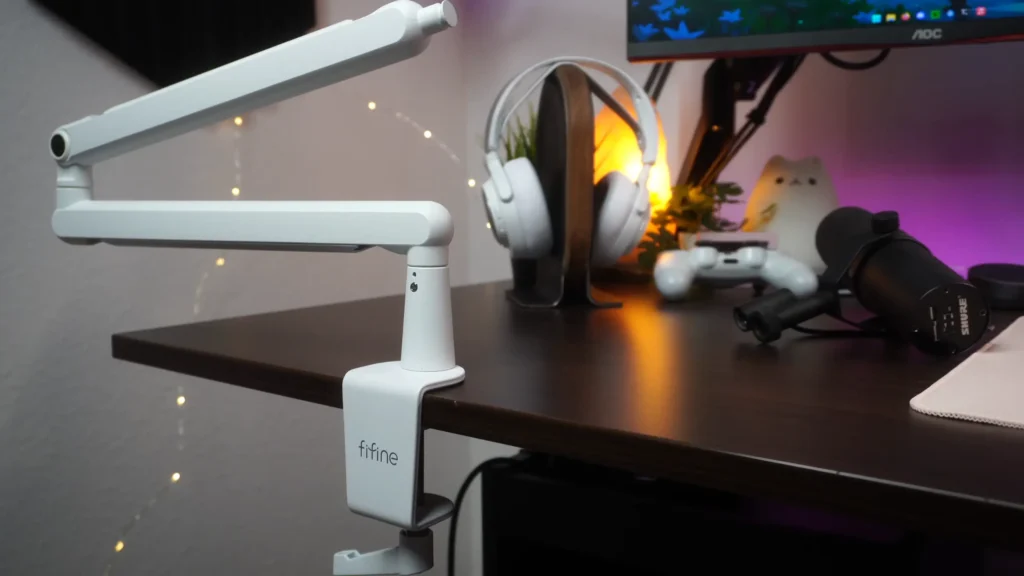
The rounded corners and slim profile give it a modern, understated look. Mount a FIFINE Tank 3 or AM8 on the white version, and the whole setup looks like it belongs in a product photo. It’s the kind of gear that makes a $200 desk setup look like it costs twice that.
The low-profile design also means you can fold the arm flat against your desk when you’re not recording, freeing up your workspace completely.
Range of Motion — 7.5/10
The BM88 offers good reach — roughly 26 inches from the center of the desk clamp column to the end of the arm when fully extended. That’s enough to position your mic in front of your face from a clamp mounted at the back or side of most desks.
Adjustable Joints
The arm has multiple joints, each adjustable with the included Allen wrench. The base joint moves horizontally (not vertically, which is expected for a low-profile arm). The middle joint offers both horizontal and vertical movement, and several reviewers, like @davesoltura, confirmed it can rotate a full 360° if you need it to.
Ball Joint for Your Mic
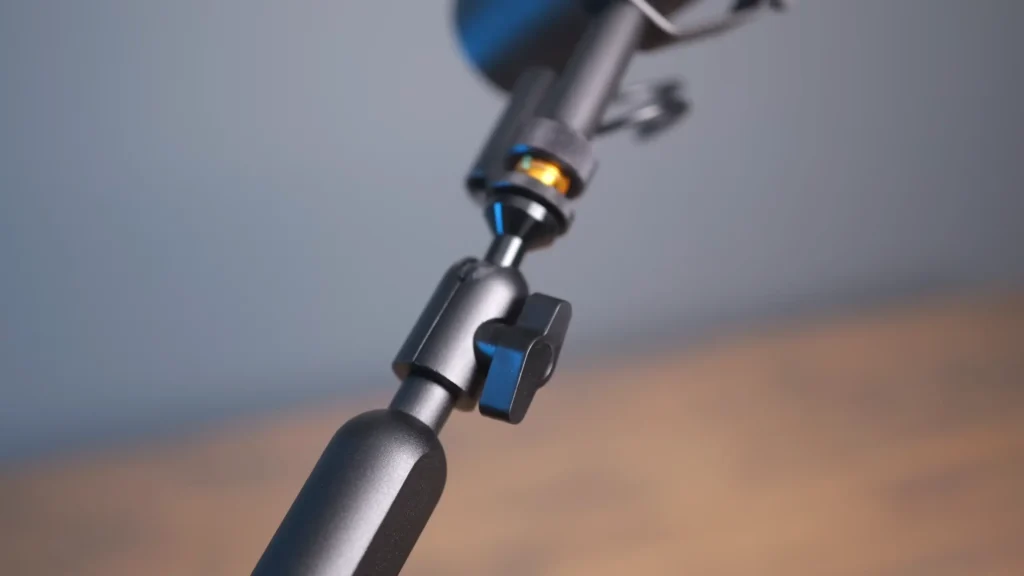
There’s a ball joint at the mic end for fine-tuning your mic’s angle and position. It’s flexible and lets you dial in placement with precision.
However, the ball joint can’t achieve a full 90°angle. This is also the real design limitation of the FIFINE BM88 review. If you position the arm straight and want your mic pointing straight up, it’ll always sit slightly off-axis.
How to solve: You can work around this by getting creative with mic placement, angling the arm differently, or adjusting your mic’s orientation on the yoke.
Install Tip
When you first mount a mic, turn the Allen wrench on the tension screw, tighten the joints, and the arm holds position firmly. Always position the arm slightly higher than your target height and let it settle for a moment. It’ll lock in just right.
Cable Management — 8.5/10
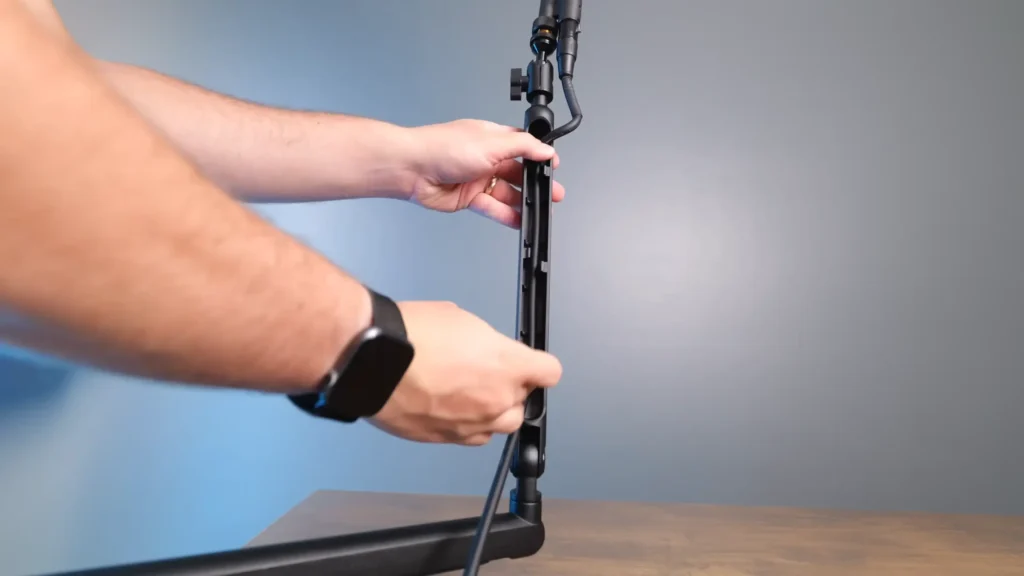
FIFINE built cable management channels directly into the arm segments, and they actually work well. Each channel has a removable tray that slides out with a satisfying snap — follow the arrow direction to open, reverse to close.
Thread your XLR cable through the channels, leave a bit of slack at each joint for movement, and snap the trays back on. The result is a clean, professional look with only small sections of cable visible at the pivot points.
Where many budget mic arms use cheap clips or Velcro strips, the BM88’s integrated channels stay put. They don’t rattle, they don’t slide off, and they keep your cable routed neatly without adding bulk to the arm’s profile.
Ease of Setup — 8/10
FIFINE BM88 setup is straightforward. Clamp it to your desk, insert the arm into the column, attach the ball mount, and screw on your mic.
Three Threads Compatibility
The arm comes with thread adapters to cover three common sizes: 1/4″-20 (the native thread), 3/8″, and 5/8″. It works with virtually any microphone or shock mount on the market. You can even mount a small camera or webcam on the arm using the 1/4″-20 thread.
One minor note: if you’re mounting a mic with a larger thread size (like the Shure SM7B), you may need to thread the adapter into the mic first, then attach the combined unit to the ball mount.
Allen Wrench vs Spring-Loaded
The Allen wrench adjustment system is less convenient than spring-loaded arms like the Røde PSA1, which hold position instantly when you move them. With the BM88, repositioning your mic means loosening the joint, moving it, and retightening.
For a set-it-and-forget-it setup, BM88 is fine, but if you frequently reposition your mic, a spring-loaded arm like Røde PSA1 might suit you better.
Mic Compatibility — 9/10
We evaluated the BM88 with several microphones across different weight classes, and it handled all of them without issue:
| Microphone | Weight | Result |
|---|---|---|
| FIFINE K669D | Light | Holds with ease |
| FIFINE AM8 | Medium | Stable, looks great |
| FIFINE Tank 3 | Medium | Perfect match |
| FIFINE K688 | Medium | Solid hold |
| Shure SM7B | Heavy (~0.77 kg) | Holds well after tension adjustment |
The BM88’s max payload is 1.5 kg. The Shure SM7B — one of the most popular broadcast mics — weighs roughly half that, so you’ve got significant headroom. The arm also clears the XLR connector on bottom-entry mics like FIFINE AM8, which is a common pain point with other low-profile arms, where the cable port can bump against the arm segment.

Value for Money — 9/10
At around $60, the BM88 sits $40 below the Elgato Wave Mic Arm LP ($99) while delivering a nearly identical feature set: all-metal construction, low-profile design, integrated cable management, and versatile mounting options.
The design differences between the two are largely cosmetic, and multiple reviewers actually preferred the BM88’s rounded aesthetic over the Elgato’s more angular look. The BM88 also beats the Elgato on max payload (1.5 kg vs. the Elgato’s comparable capacity) and on branding discretion.
You’re not getting a spring-loaded mechanism at this price — that’s the tradeoff. But for the vast majority of content creators who set up their mic once and leave it, the Allen wrench system works perfectly fine.
Who Is the FIFINE BM88 For?
| If you are… | The BM88 is… |
|---|---|
| A YouTuber who wants a clean, on-camera setup | A great fit — minimal branding, stays out of frame |
| A podcaster on a budget | Ideal — sturdy enough for daily use, priced right |
| A streamer using a heavy mic like the SM7B | Well suited — 1.5 kg max payload handles it easily |
| Someone who repositions their mic constantly | Worth considering, but a spring-loaded arm may be more convenient |
| A voice actor looking for a secondary arm | A solid option for a second mic or camera mount |
FIFINE BM88 Alternatives
Elgato Wave Mic Arm LP
Price: ~$99
- Pros: Established brand, widely reviewed, clean design
- Cons: $40 more expensive, heavier branding than the BM88
Elgato Wave Mic Arm LP is a strong option if you want the reassurance of a well-known brand, but you’re paying a premium for the name.
Røde PSA1
Price: ~$99
- Pros: Spring-loaded (no Allen wrench needed), proven long-term durability
- Cons: Not low-profile, visible springs and bars, max load 1.2 kg
The Røde PSA1 is a different category — a traditional boom arm rather than a low-profile design. It’s better for voice actors and anyone who needs to reposition their mic constantly, but it will show up in your camera frame.
Final Verdict on FIFINE BM88 Review
Among the multiple useful microphone boom arms, the FIFINE BM88 delivers where it counts: solid metal build and enough strength to hold even heavy mics. The integrated cable management is thoughtfully designed, and the thread adapters cover every common size. The obvious value? It’s budget-friendly.
The ball joint’s inability to hit a true 90°angle and the Allen wrench system won’t appeal to everyone. But if you want a low-profile mic arm that won’t break the bank or break your desk, the BM88 belongs on your shortlist.
FAQs
How much weight can the FIFINE BM88 hold?
The BM88 supports a maximum payload of 1.5 kg (about 3.3 lbs), which comfortably handles heavy mics like the Shure SM7B.
What desk thickness does the clamp support?
The clamp fits desks from approximately 3/4″ to 2.4″ thick. You’ll also need about 2.1″ of depth at the clamping point.
Can I mount a camera on the BM88?
Yes. The ball mount uses a 1/4″-20 thread natively, which is the standard camera tripod thread. You can mount webcams, small cameras, or other accessories.
Is the BM88 spring-loaded?
No. It uses an Allen wrench tension system. You tighten the joints to hold your mic in position. This is typical for low-profile arms in this price range.
How does the BM88 compare to the Elgato Wave Mic Arm LP?
The two arms offer very similar features — all-metal build, low-profile design, cable management — but the BM88 costs roughly $40 less. Design-wise, the BM88 has less visible branding and a slightly different aesthetic with rounded corners.
