
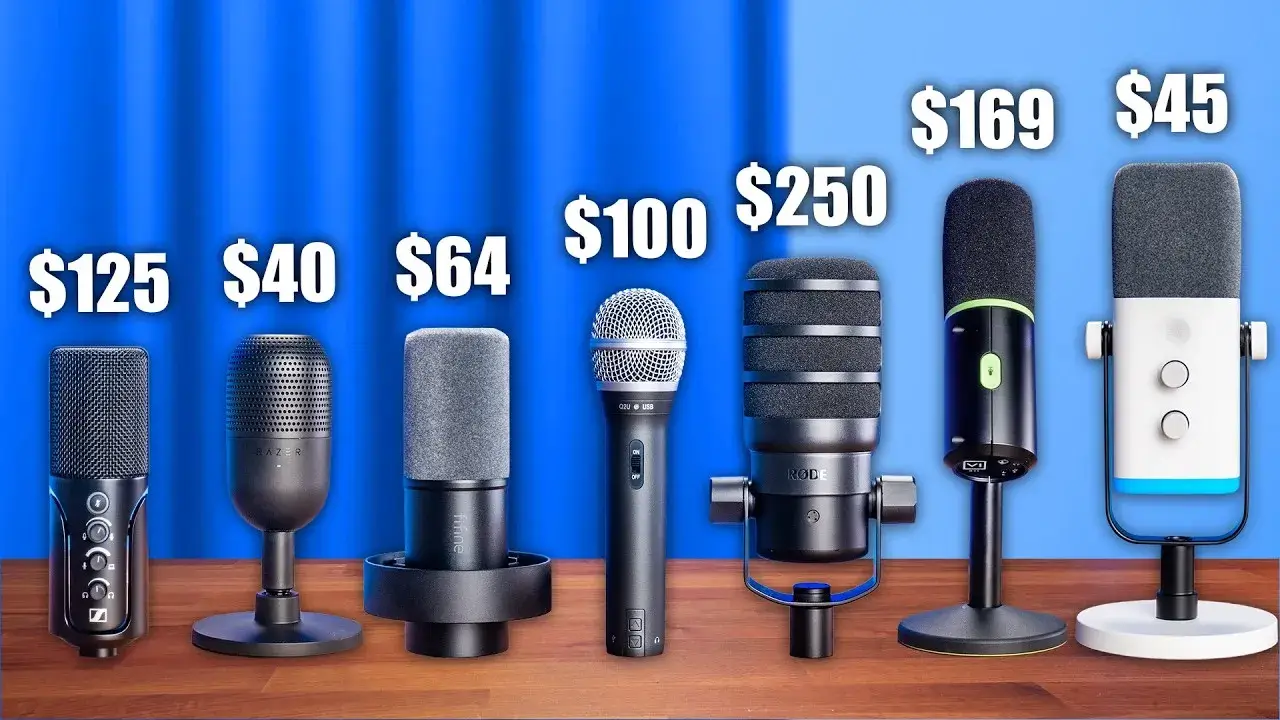
5 Best Budget Microphones in 2026 (All Tested)

Today, microphones priced between $30 and $100 can produce audio quality comparable to that of microphones three or four times the price. FIFINE has emerged as a market leader in this budget category, constantly releasing mics that outperform their weight class.
But, with so many alternatives available, how to pick the best budget microphones? That is exactly what we are here to discover. In this guide, we’ve compiled insights from extensive real-world testing, comparing everything from raw audio quality to noise isolation. We’re looking at these microphones the way you’d actually use them. Let’s dive into them right now!
Top 5 Budget Microphones at a Glance
- FIFINE K688 – Best Overall
- FIFINE AM8 – Best Value
- FIFINE Tank 3 – Best Build Quality
- FIFINE K669 – Best Entry-Level
- FIFINE K678 – Best Feature Set Under $50
What We Tested For
Every microphone in this roundup was evaluated based on:
- Audio Quality: How does it sound out of the box? Is it clear, warm, or muddy?
- Build Quality: Metal or plastic? Will it survive being knocked over?
- Noise Isolation: How well does it reject keyboard clicks, fans, and background noise?
- Plosive Handling: Can it handle hard “P” and “B” sounds without popping?
- Connectivity: USB only, or does it offer XLR for future upgrades?
- Value: Are you getting your money’s worth?
5 Best Budget Microphones: Detailed Reviews
FIFINE K688 – Best Overall
Score: 9.5/10
Pros:
- Professional broadcast sound quality out of the box
- Full metal construction feels premium
- Built-in shock mount reduces handling noise
- USB-C and XLR connectivity for flexibility
- Excellent noise rejection
- Removable pop filter included
Cons:
- No desk stand included
- Early batches had USB cable issues (now resolved)
- Controls located on the back can be inconvenient
- No RGB if that matters to you
The FIFINE K688 microphone is one of the most appealing microphones in this roundup. It’s essentially a love letter to the Shure SM7B, and that’s not a bad thing. The full metal casing, the velvety foam windscreen, a warm, broadcast-ready tone—everything about this mic screams “I mean business.”
With the dynamic capsule, you won’t pick up your mechanical keyboard or that loud PC fan. Plus, the USB-C and XLR connectivity make this mic grow with your setup. Start with a USB for simplicity, then upgrade to XLR when you invest in an audio interface. At around $70-80, the K688 offers tremendous value for anyone serious about their audio quality.
One thing worth noting: earlier production runs had some issues with crackly USB cables, but FIFINE has since corrected this by switching to USB 2.0 cables. If you’re buying new, you shouldn’t encounter this problem.
FIFINE AM8 – Best Value
Score: 9.2/10
Pros:
- Exceptional price-to-performance ratio
- Outstanding background noise rejection
- Includes desk stand (and optional boom arm bundle)
- Customizable RGB lighting
- Touch-sensitive mute button
- USB and XLR connectivity
Cons:
- Plastic feels less premium
- A large profile may dominate your camera frame
- Lower output volume requires close positioning
- Front-mounted controls can be awkward to adjust
- The touch mute button can be accidentally triggered
The FIFINE AmpliGame AM8 microphone has become something of a legend, in that you don’t need to spend $400 on an SM7B to sound professional. And here’s the thing: during blind listening tests with multiple participants, most people couldn’t reliably distinguish between the AM8, K688, and Tank 3.
What sets the FIFINE AM8 apart is its noise isolation. The thick, removable pop filter acts like a fortress against plosives and background noise. For sound signature, AM8 leans slightly toward the higher frequencies, giving voices added clarity and presence. Plus, the customizable RGB would satisfy you if you’re building an aesthetic streaming setup; the AM8 fits right in.
However, the difference comes in build quality. Where the K688 feels like a tank, the AM8 is noticeably more plastic. Will it break if you knock it over? Probably not. But it doesn’t have that same reassuring heft.
FIFINE Tank 3 – Best Build Quality
Score: 9.0/10
Pros:
- Exceptional metal construction throughout
- Half-yoke mount with side-mounted controls
- Neutral, balanced sound signature
- Physical mute button with tactile feedback
- Improved headphone monitoring volume
- Low-profile design for streaming
Cons:
- Higher price point than competitors
- The mute button can be rattly
- Lacks the bass warmth some users prefer
- Yoke mount tension adjustment isn’t super tight
- Cannot use third-party shock mounts due to side controls
The FIFINE AmpliTank Tank3 USB/XLR microphone represents FIFINE’s flagship offering, and it shows. The almost entirely metal construction is genuinely impressive. The half-yoke mount design is a clever innovation. FIFINE places the gain and headphone volume controls on the side rather than the front or back. You can adjust your levels mid-recording without moving away from the capsule.
Sound-wise, the Tank3 sits in the middle ground. Where the AM8 leans bright, and the K688 leans warm, the FIFINE Tank3 aims for neutrality. If you’re producing hours-long streams or podcasts, this balanced sound profile might be easier on your audience’s ears.
The physical mute button is a welcome addition over the touch-sensitive buttons on the AM8 and K688. You can mute quickly when you press it. The trade-off? It can produce a slight click sound that might get picked up if you’re muting during a recording.
FIFINE K669 – Best Entry-Level
Score: 8.5/10
Pros:
- Incredibly affordable at ~$30
- Full metal casing despite the low price
- Includes an adjustable desktop stand
- Simple plug-and-play USB setup
- Good baseline audio quality
Cons:
- Non-detachable cable
- No pop filter or windscreen included
- Condenser design picks up more background noise
- USB-only connectivity
- No RGB & Headphone monitoring
When FIFINE K669 microphone first launched at around $40, it was revolutionary—a USB condenser mic that actually sounded decent without any fancy setup required. Today, with prices often dipping to around $30, the K669 remains a solid entry point. The full metal casing is impressive at this price point, and the included desktop stand means you can start recording immediately without buying additional accessories.
The sound quality is perfectly acceptable for voice calls, casual streaming, and getting your feet wet with content creation. K699 might not be completed with the AM8 or K688. But if you’re not sure whether podcasting or streaming is right for you, the K669 lets you experiment without risking much money.
One important note: as a condenser microphone, the K669 will pick up more ambient noise than the dynamic microphones higher on this list. If you have a noisy environment, you might want to consider the AM8 instead.
FIFINE K678 – Best Feature Set Under $50
Score: 8.3/10
Pros:
- Detachable USB cable for easier cable management
- Built-in headphone output for monitoring
- Two-volume knobs (mic level and headphone)
- Physical mute button with LED indicator
- Extension tube included for boom arm mounting
Cons:
- Still a condenser (picks up more background noise)
- USB-only connectivity
- No significant audio quality improvement over K669
Think of the K678 as the K669’s more mature sibling. For an extra $10, you get a bunch of quality-of-life improvements that make a real difference in day-to-day use.
The detachable USB cable means you can replace the cable if it gets damaged. The headphone output lets you monitor your audio in real-time without latency, which is essential for podcasting and voiceover work. And the physical mute button with its status LED makes it easy to see at a glance whether you’re live or muted.
The audio quality in FIFINE K678 is similar to the K669—we’re still talking about a cardioid condenser microphone at the end of the day. If you’re upgrading from the K669, you’re paying for convenience features rather than sound improvements.
Buying Guide: What to Look for in a Budget Microphone
Choosing the right microphone isn’t just about price—it’s about finding the best fit for your specific needs. Here’s what to consider before making your decision.
Microphone Type: Dynamic vs. Condenser
This is probably the most important decision you’ll make. Dynamic microphones (like the K688, AM8, and Tank 3) are more focused and reject background noise naturally. They’re ideal if you’re recording in a less-than-perfect environment with fans, keyboards, or family members making noise.
Condenser microphones (like the K669 and K678) are more sensitive and capture more detail, but they also pick up more ambient sound. They work best in treated rooms or very quiet environments.
Our recommendation: For most streamers and content creators, a dynamic microphone is the safer choice unless you have a dedicated, quiet recording space.
Connectivity: USB vs. XLR vs. Hybrid
USB microphones plug directly into your computer—no additional hardware needed. XLR microphones require an audio interface, which adds cost but gives you more control over your sound and typically better audio quality.
Several FIFINE microphones (K688, AM8, Tank 3) offer both USB and XLR connectivity. This hybrid approach is fantastic for future-proofing: start with USB for simplicity, then upgrade to XLR when you’re ready to invest in an audio interface.
Build Quality
Build quality affects both durability and, surprisingly, audio quality. Metal microphones tend to resist vibrations better than plastic ones, which can translate to cleaner recordings.
The Tank 3 and K688 lead the pack here with their substantial metal construction. The AM8, while more plastic, still offers reasonable durability for its price point.
Features That Matter
- Headphone monitoring: Essential for podcasting and voiceover work. Let you hear yourself in real-time without latency.
- Mute button: Crucial for streaming and calls. Touch-sensitive buttons are silent; physical buttons offer better feedback.
- Gain control: On-mic gain adjustment is convenient but not essential—you can adjust gain in software too.
- Shock mount: Reduces handling noise and desk vibrations. Built-in shock mounts (like on the K688) are a nice bonus.
Use Case Considerations
For streaming:
The AM8 or K688 are excellent choices. The AM8’s RGB lighting fits gaming setups, while the K688’s professional look works for more polished streams. Both offer the noise rejection streamers need.
For podcasting:
The K688’s broadcast sound and professional aesthetic make it ideal. The Tank 3’s neutral sound profile is also great for long-form content.
For voiceover work:
The AM8’s clarity in higher frequencies makes voices pop. Its exceptional noise isolation also helps when recording at home.
For beginners on a tight budget:
The K669 lets you get started for minimal investment. Upgrade later once you know content creation is for you.
Conclusion
So, the overall best budget microphone we’ve tested is certainly the FIFINE K688. Its broadcast-level sound, solid build, and flexible connectivity are hard to beat at $70–80.
That said, the $55 AM8 sounds almost identical. If you want a cheaper option or RGB lighting, the AM8 is arguably the smarter choice. If durability matters most, the Tank 3’s tank-like build justifies its higher price. And for beginners, the K669 is still a reliable, affordable entry mic.
You don’t need to spend hundreds to sound good. Choose what fits your budget and setup, hit record, and you’re good to go.
FAQs
Which microphone is best for a noisy environment?
The AM8 offers the best noise isolation thanks to its thick pop filter and focused pickup pattern. The K688 and Tank 3 are also good choices. Avoid condenser microphones like the K669 if background noise is a concern.
Is there a noticeable sound quality difference between the K688, AM8, and Tank3?
The differences are subtle. The K688 has slightly more bass warmth, the AM8 has more clarity in the high frequencies, and the Tank3 sits neutral in the middle. In blind tests, many listeners can’t tell them apart.
Do I need a boom arm?
Not necessarily. The AM8, K669, and K678 all come with desk stands. However, a boom arm lets you position the microphone closer to your mouth (which improves sound quality) while keeping your desk clear. The AM8 is even available in a bundle with a boom arm.
What’s the difference between dynamic and condenser microphones?
Dynamic microphones (K688, AM8, Tank 3) are more directional and reject background noise better—ideal for untreated rooms. Condenser microphones (K669, K678) are more sensitive and pick up more detail but also more ambient sound—best for quiet, treated spaces.
Do these microphones require phantom power?
No. When using a USB, it’s powered by your computer. When using XLR with the K688, AM8, or Tank 3, phantom power is not required—these are dynamic microphones.
