
ANC vs Passive Noise Isolation: Which One Makes Your Audio Better?

When you go to the fifine X3 product page, you may find “Active Noise Cancellation (ANC)” in the description. So does the “passive noise isolation” on the fifine H13 product page. Noise reduction has many approaches. Does ANC work the same as passive noise isolation?
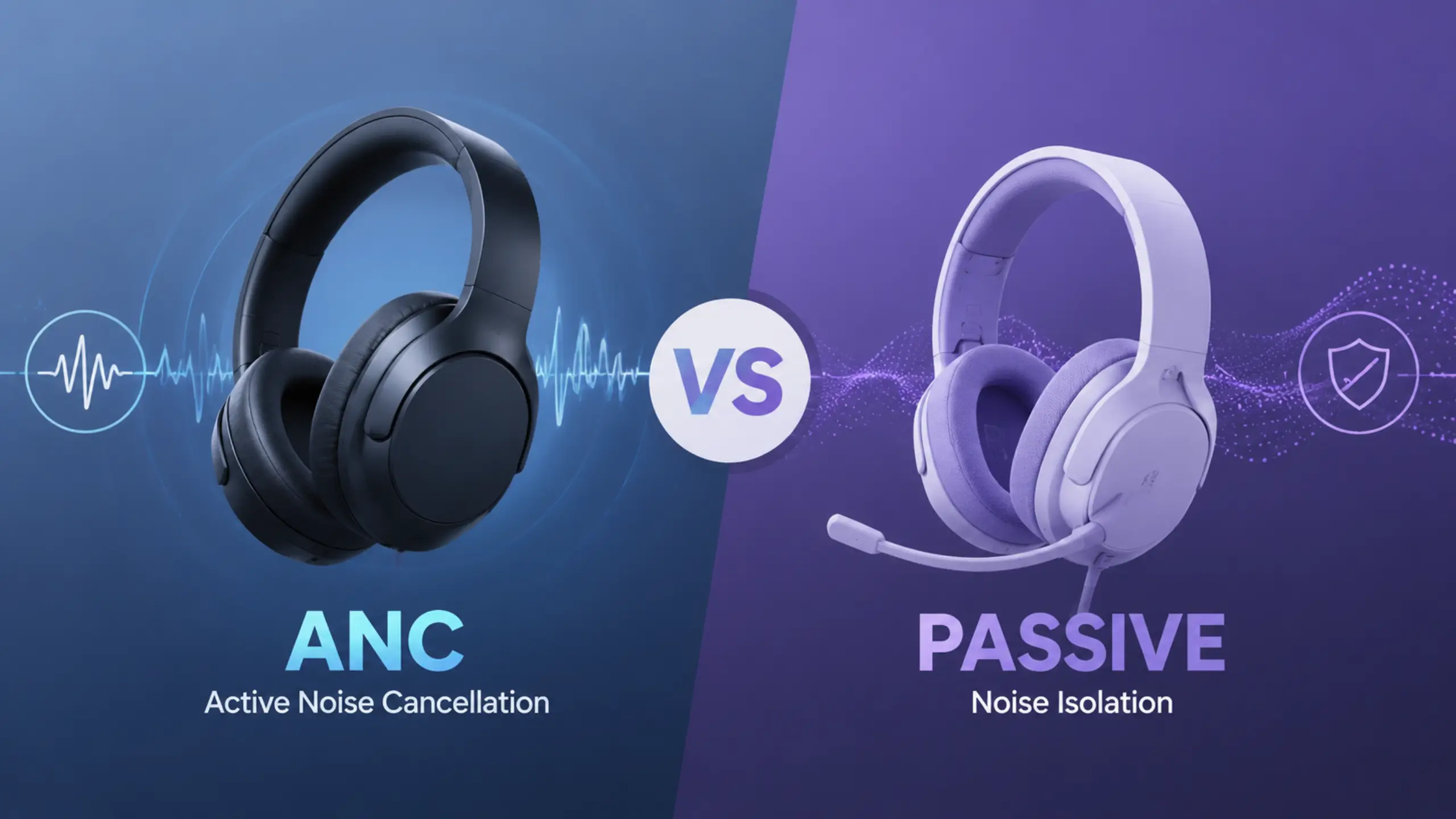
ANC vs passive noise isolation? The key difference is in the cancellation or isolation. We’ll use two headphones to discuss them in this guide: the fifine X3 wireless ANC headphones and the fifine H13 gaming headset, which solve the noise problem from opposite ends.
Quick Comparison for ANC vs Passive Noise Isolation
| Active Noise Cancellation (ANC) | Passive Noise Isolation | |
|---|---|---|
| How it works | Mics listen, processor generates anti-noise | Physical barrier: ear cups, pads, seal |
| Needs power? | Yes | No |
| Best against | Steady low-frequency drone | Sudden, high-frequency, irregular sound |
| Struggles with | Loud transients, mid-range voices | Deep bass that vibrates through material |
| Affects your audio? | Slight processing, varies by model | No processing at all |
| Cost impact | Adds to the price | Comes from build quality |
| Typical use | Flights, trains, commutes, open offices | Gaming, studio work, shared spaces |
What Is Active Noise Cancellation (ANC)?
Active noise cancellation is a technology that reduces unwanted sound by producing sound of its own. “Active” is the operative word: it’s a system doing continuous work, powered by your battery, reacting in real time to whatever it hears. Take away the power and the cancellation goes with it.
How ANC Works
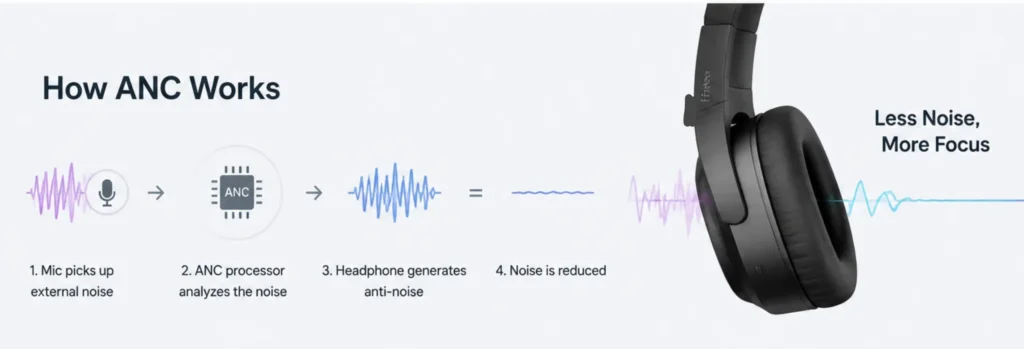
Think about a small computer in your ear cup. Here’s what it does:
- External mics capture the sound around you. Tiny microphones on the outside of each ear cup sample the ambient noise continuously.
- The processor analyzes what it hears. It identifies the waveform of the incoming noise — its frequency, its amplitude, its pattern.
- The headphone generates anti-noise. It plays back a wave shifted half a wavelength out of phase with the noise. Peaks meet troughs. The two waves largely cancel, and the noise reaching your eardrum drops.
That’s the whole trick. Two identical waves stacked in phase get louder. Delay one by half a wavelength, and they fight each other instead. But total silence is impossible. You get a substantial reduction, not an erasure.
ANC Shines Against:
- Airplane engine noise
- Subway and train rumble
- Highway traffic and road drone
- Air conditioning and fan hum
All of these are low-frequency and consistent. The processor gets to hear the noise, model it, and stay locked onto it — because the noise isn’t going anywhere.
The flip side shows up with transients for ANC. Human speech sits in an awkward middle zone too: in fifine X3 review, the X3 headphone handled steady ambient noise well and had a harder time with mid-level sounds like nearby conversation. That’s not a specific X3 flaw. It’s how ANC behaves as a category.
What Is Passive Noise Isolation?
Passive noise isolation is noise reduction that comes from physical design alone — no electronics, no processing, no power. The headphone blocks sound the way a closed door blocks sound: material and a tight seal stand between your ear canal and the room, and whatever can’t get through simply doesn’t reach you.
It’s “passive” because nothing is running. The reduction is built into the shape and the materials, so it’s there the moment you put the headphone on, and it never switches off.
How Passive Noise Isolation Works
- Closed-back ear cups, which seal the driver off from the outside rather than venting it
- Ear pad material and density — memory foam, faux leather, silicone
- The seal against your head, which is where most of the performance actually comes from
- Physical mass between your ear canal and the room
Fit is everything here. A well-sealed over-ear can cut external sound by 20 to 30 dB or more, but the same headphone with a broken seal — pushed off by glasses arms— drops off fast. It’s also why in-ear designs with silicone or foam tips can outperform much larger headphones.
That said, better isolation means you listen at lower volume to get the same clarity. It’s a quiet, cumulative win over years of listening.
What Noise Does Passive Isolation Handle Best?
- Keyboard and mouse clicks
- Nearby conversation
- Room noise, doors, footsteps in the hallway
- Sudden environmental sounds with no warning
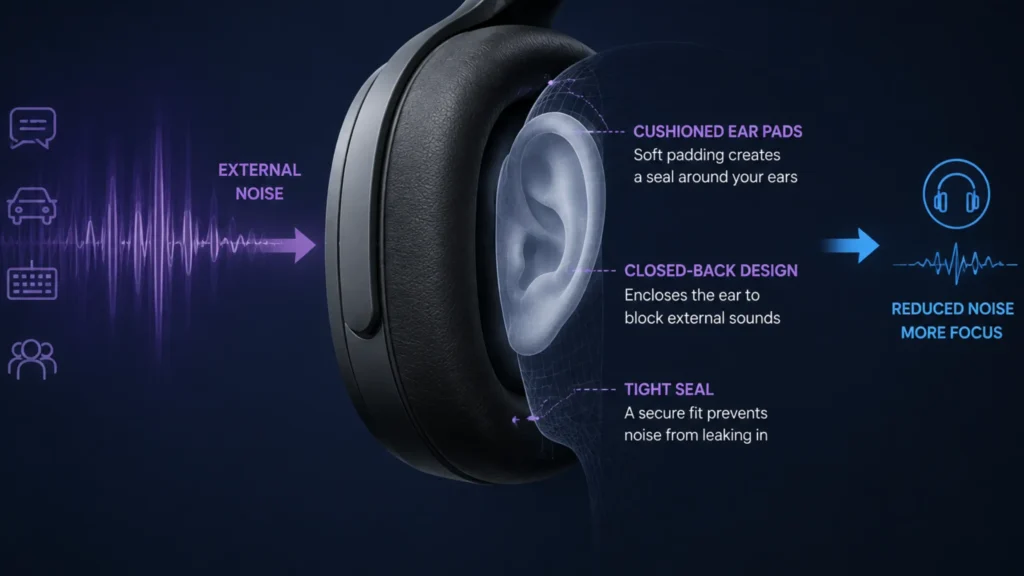
These are the sounds ANC finds hardest — irregular, higher-frequency, over before a processor can respond.
A physical barrier attenuates whatever arrives, the instant it arrives. The limit is bass. Enough low-frequency energy will vibrate straight through foam and leather. Deep drone is the one thing a passive seal can’t fully stop.
Key Differences: ANC vs. Passive Noise Isolation
| Dimension | ANC | Passive Isolation |
|---|---|---|
| Mechanism | Electronic wave cancellation | Physical barrier |
| Power | Required — no battery, no cancellation | None |
| Frequency strength | Low frequencies | Mid and high frequencies |
| Response to transients | Weak; can distort | Immediate and consistent |
| Depends on fit? | Somewhat | Almost entirely |
| Signal purity | Adds processing to the chain | Leaves the signal alone |
| Failure mode | Battery dies, effect gone | Seal breaks, effect drops |
| Price driver | Chip, mics, tuning | Materials and build quality |
One Runs, One Just Is
ANC needs power, a chip, and a live read of your surroundings. Passive isolation works whether the headphone is on, off, or dead. When you’re on hour nine of a flight with a flat battery, you’ll find ANC is a feature that can stop working; passive isolation is a property of the object.
They Cover Different Frequencies
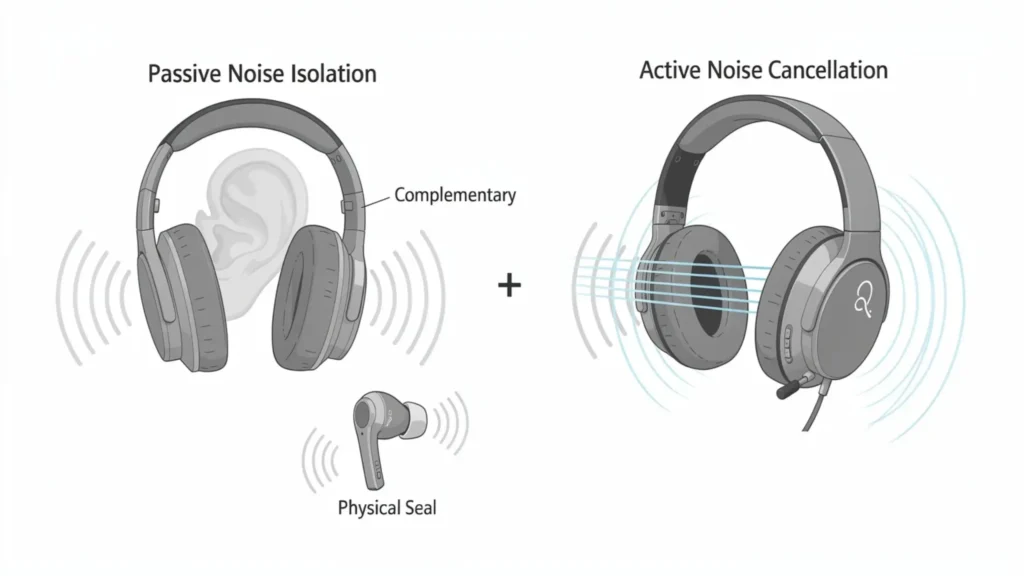
ANC does its best work on low, long waves. Passive isolation is weakest there and gets stronger as frequencies climb, since short waves are easier to physically block. They’re covering each other’s gaps. Where they genuinely overlap is the human voice band, and neither wins cleanly.
Fit Breaks One, Surprise Breaks the Other
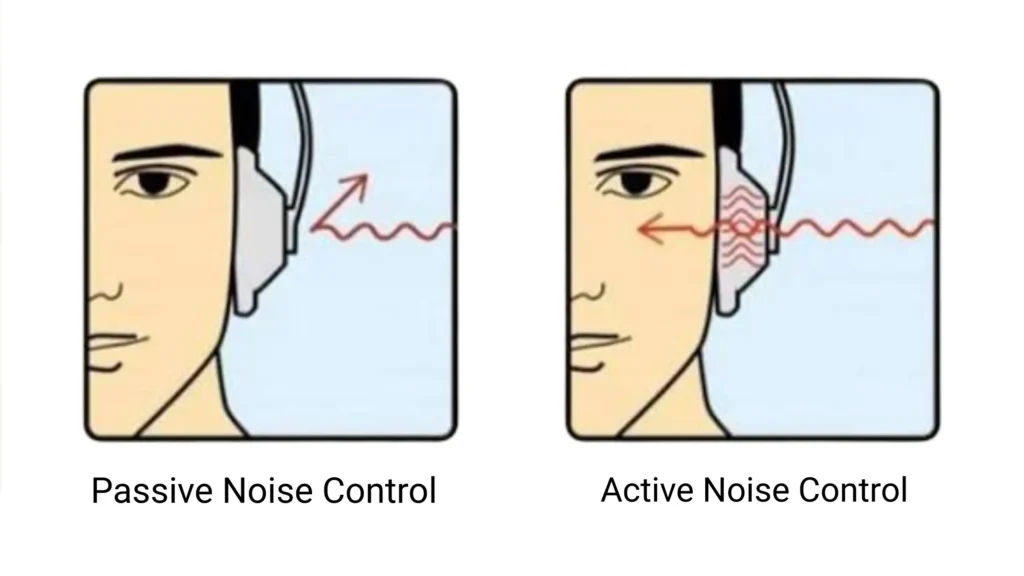
Passive isolation lives on the seal. The wrong ear tip size costs you most of the performance instantly. ANC is fussy about the noise itself: it wants predictable, repeating sound.
What Each One Costs You
ANC adds a subtle processing stage between source and ear. It’s also a line item on the price tag. Passive isolation comes free with build quality, so a well-made $55 headset can out-isolate a sloppy $150 one.
ANC vs Passive Noise Isolation: Which One is Better?
Let’s look at the fifine X3 headphone and the H13 headset to find where ANC or passive noise isolation works best.
For Travel and Commuting: ANC Has the Advantage
Some constant noise like traffic and road noise is the textbook ANC case. It’s loud, it’s low, and it never stops.
Engineers who’ve measured cabin noise with an SPL meter at highway speed have logged 87 to 90 dB SPL with no music playing — past what OSHA guidelines consider safe for extended exposure. Turn on the stereo, and it climbs further.
For long-term commuting, ANC headphones let your ears get a break and help your brain pull signal out of the floor, and fatigue follows.

fifine X3 wireless headphones — everyday listening
- ANC that’s obvious the second you flip it on — the ambient floor drops enough that you notice the silence, not the feature
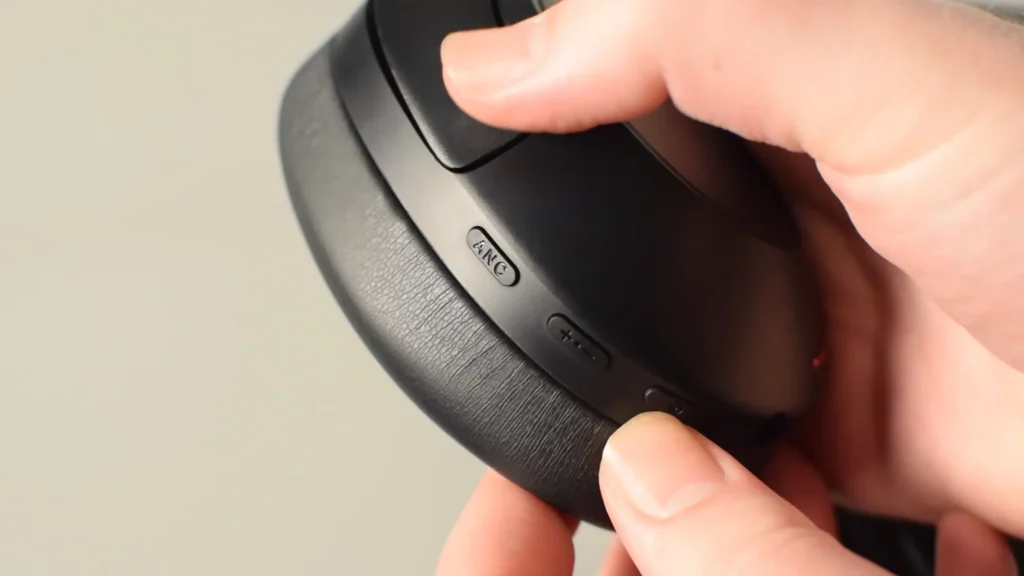
- Transparency mode — hold the right ear cup and catch a gate announcement without pulling the headphones off
- Up to 33 hours of playback — the ANC is still running on the return leg
- Multipoint pairing — laptop and phone at once, auto-switching when a call comes in
- A 3.5 mm cable in the box — dead battery doesn’t mean dead headphones
For Gaming: Passive Noise Isolation is Better
Competitive gaming asks for something different. You need footsteps placed accurately, directional cues intact, positional detail undamaged. Every processing stage between the game engine and your ear is a chance to smear that information.
Passive noise isolation adds zero stages. It reduces the room without touching the signal — and it responds instantly to the exact sounds that break concentration mid-match, which are the irregular ones. However, a perfect fit matters more for a competitive player.
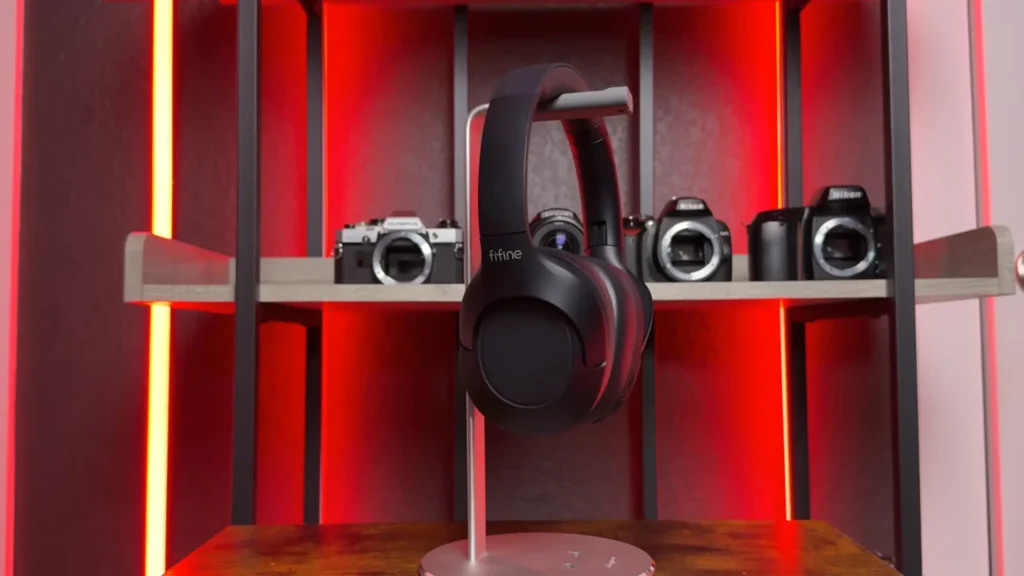
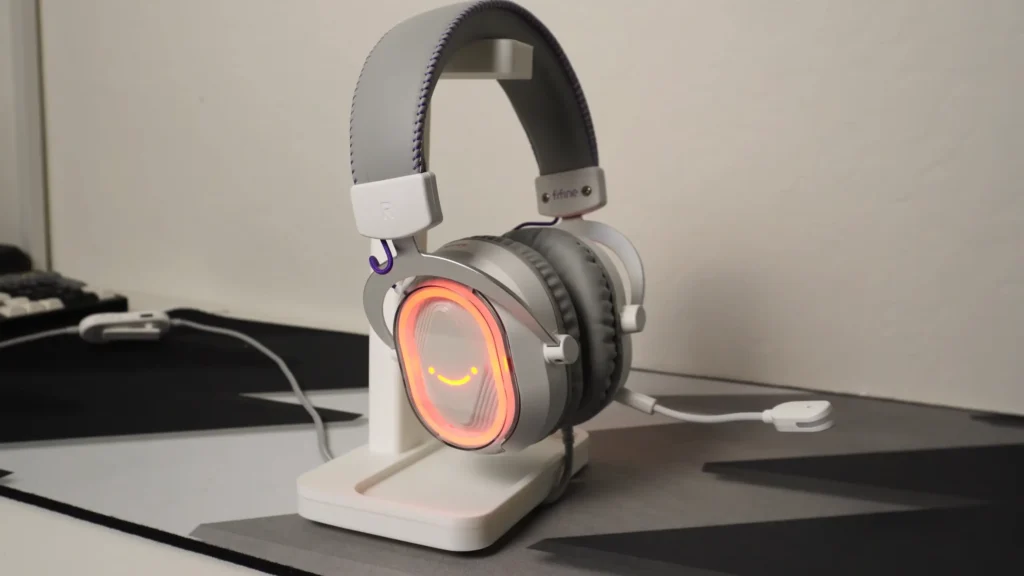
fifine H13 gaming headset — focused gaming
- Closed-back cups with a real seal — you can keep volume reasonable without outside sound bleeding in
- Soft faux leather cushions, gentle clamping force — no vice grip after two hours, and glasses wearers reported no pressure points
- Directional accuracy that holds — in Overwatch practice-range testing, footsteps registered clearly from behind, from the left, from above
- Comfort tuned for the long haul — the other half of what FPS marathons and streaming sessions demand
Wrapping Up
Understanding ANC vs passive noise isolation helps you choose the right audio experience. ANC is ideal for reducing constant background noise during commuting or travel, while passive noise isolation helps block distractions and maintain natural sound during gaming and focused listening.
The fifine X3 ANC headphones create a quieter listening environment, while the fifine H13 headset relies on passive isolation for immersive gaming. Pick the technology that fits your lifestyle and enjoy an immersive audio experience with fifine.
FAQ
Does ANC damage your hearing?
No. If anything it helps — a lower noise floor means you turn the volume down to hear the same detail, and volume is what causes damage.
Why does my ANC sound weird near loud drums or machinery?
The system is trying to model a sound that changes faster than it can respond. Sharp transients are ANC’s hardest case. Passive isolation handles that environment better.
Do I still get noise reduction if the battery dies?
Yes — whatever the ear cups provide physically. On the X3 you can also switch to the 3.5 mm cable and keep listening with no power at all.
Is passive isolation the same as “noise canceling” on a headset mic?
No, and this trips people up constantly. Mic noise cancellation cleans up what your teammates hear. Passive isolation affects what you hear. The H13 has both, and they’re unrelated features.
Which should I prioritize on a tight budget?
Good passive isolation is a build-quality outcome, so you get it from a well-made $55 headset. Weak ANC on a cheap headphone is a feature that doesn’t quite deliver; a good seal always delivers.
