

Active Noise Cancellation Explained: How ANC Works in the fifine X3 Bluetooth Headphones

Press the ANC button on a pair of headphones and something odd happens. The air conditioner hum disappears. The bus engine flattens into a distant murmur. Meanwhile, your coworker’s laugh still cuts right through. You may ask, if the headphones can kill an engine, why can’t they kill a laugh?
That’s because Active Noise Cancellation (ANC) does something stranger: it produces its own sound, aimed directly at the noise, and the two flatten each other out. Here’s what’s actually happening inside the earcups, why it works better on some noises than others, and how ANC behaves on the fifine X3 Bluetooth headphones.
What Is Active Noise Cancellation (ANC)?
Active Noise Cancellation (ANC) is a technology that reduces unwanted ambient sound using electronics — microphones, a processor, and the headphone drivers working together in real time.
The word doing the heavy lifting is active. The headphones aren’t sitting there absorbing noise. They’re monitoring your environment continuously and generating a counter-signal as fast as the noise arrives. Contenter @granthinds sums the mechanism up as “creating a second sound wave that is 180 degrees out of phase” with the noise you’re trying to escape.
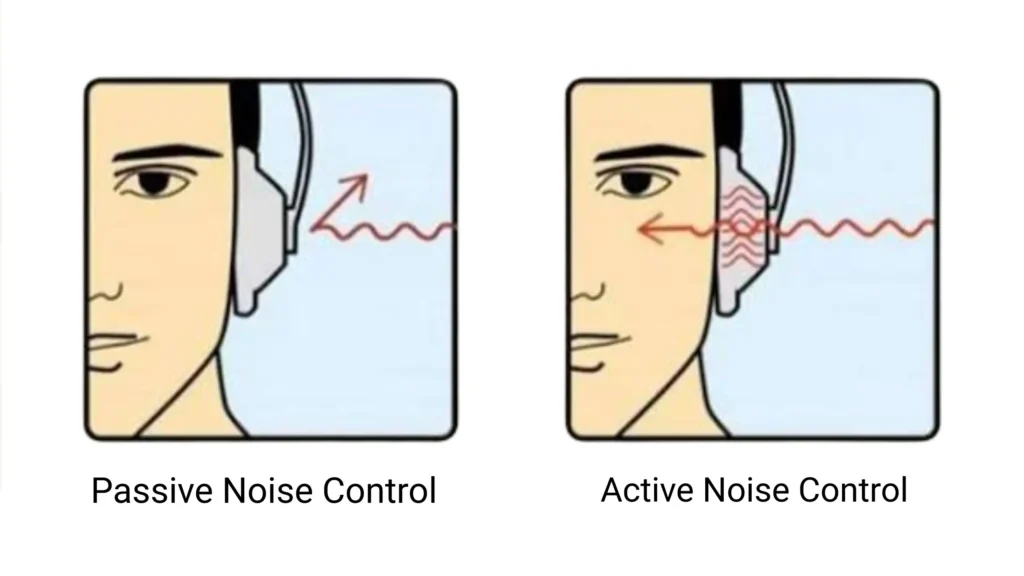
ANC vs Passive Noise Isolation
| Passive Noise Isolation | Active Noise Cancellation |
|---|---|
| Uses physical materials | Uses electronic technology |
| Blocks sound from entering | Reduces noise through sound wave cancellation |
| Depends on ear cup design | Depends on microphones and processing algorithms |
Passive isolation is the memory foam pressing against your head and the silicone tip sealing your ear canal. Over-ear cushions that fully surround the ear isolate more than on-ear pads resting on top of it. No power required, no processing, no delay. As @PakiuReviewsEng, an electronic products or gadgets reviewer, puts it, with passive isolation “we are not really cancelling the noise but we are avoiding it”.
ANC starts where passive isolation runs out — and on a well-built pair of headphones, the two stack. A tighter physical seal means less noise reaches the drivers, which leaves the ANC system a smaller, cleaner job to do.
How Does ANC Actually Work?
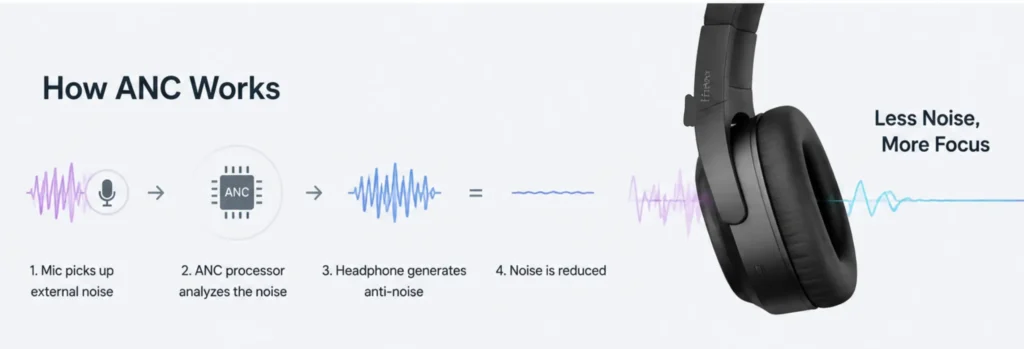
ANC works with four steps, all happening in a fraction of a millisecond.
Step 1: Microphones Detect External Noise
ANC headphones carry small built-in microphones — you’ll often spot them as pinholes on the outside of the earcups. Their only job is listening to the world around you.
They pick up the noise you’d rather not hear:
- Airplane engine drone
- Traffic and road noise
- Air conditioner and HVAC hum
- Subway rumble
There are two broad approaches. Feedforward ANC uses a microphone on the outside of the earcup to catch noise before it reaches your ear. Feedback ANC uses a microphone on the inside, sampling what’s actually arriving at your eardrum, and corrects from there. Many modern headphones combine both.
Step 2: The ANC Processor Analyzes the Noise
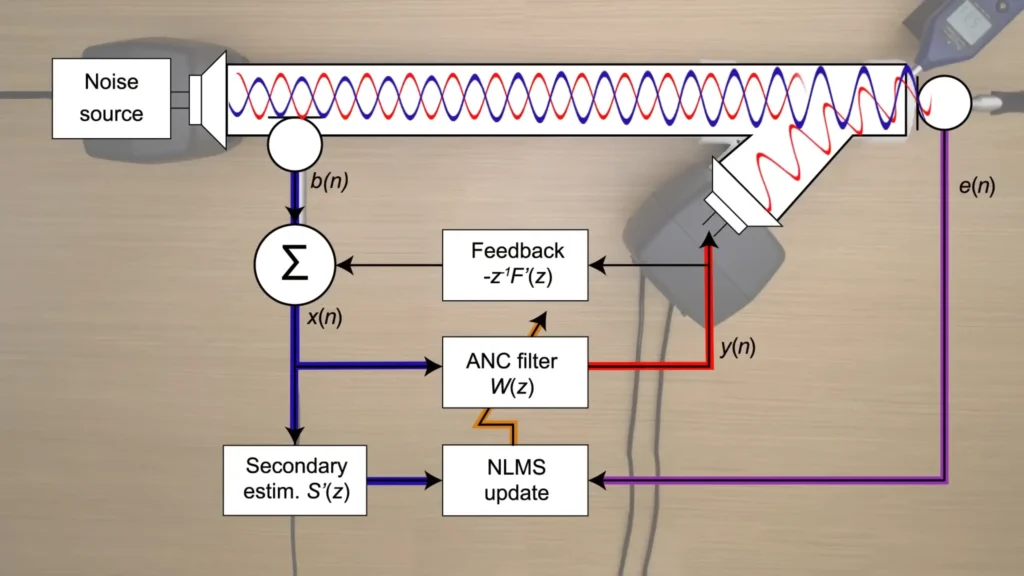
The captured signal goes to a digital signal processor, or DSP. This is the brain of the operation. The DSP measures the incoming waveform — its frequency, its amplitude, its shape — and works out what the inverse of that wave needs to look like.
There’s a complication. Sound doesn’t arrive at your eardrum in the same form it left the street. It travels a path, and that path colors it.
Two paths that sound will travel:
- The route from the noise source to the listening position
- The separate route from the anti-noise speaker to that same point.
Both get modeled, because playing back a naive flipped copy of the microphone signal wouldn’t line up. Adaptive filters handle this, adjusting their own settings continuously until the cancellation lands.
Speed matters enormously. Sound travels roughly 1,125 feet per second. Miss that window and the anti-noise arrives late — where it does nothing useful, or actively makes things worse. The faster and more accurately the processor works, the better the result. This is why two headphones can both say “ANC” on the box and perform nothing alike. Processor quality and tuning software separate a good implementation from a token one.
Step 3: The Headphones Create Anti-Noise
The DSP feeds the drivers a new sound wave: same frequency and amplitude as the noise, but 180 degrees out of phase. A peak where the noise has a trough, a trough where the noise has a peak.
The two waves meet in the air inside the earcup and cancel. Physicists call this destructive interference. Think of two ripples on a pond meeting head-on and stopping each other flat.
The chain looks like this:
External noise → ANC microphone → DSP analysis → Anti-noise → Reduced noise
Well-tuned systems in controlled lab conditions can knock target noise down dramatically. In one MATLAB and Simulink prototype built inside a length of PVC pipe, the engineers switched their control on and watched the meter fall within seconds — “the noise has reduced by around 30 dB.” Real headphones on a real head in a real subway car won’t hit that number, but the mechanism is identical.
Step 4: Your Ears Hear a Quieter Environment
Here’s the honest part: ANC does not deliver silence.
What it delivers is a reduction in intensity across specific bands of background noise. The engine drops away. The HVAC hum vanishes. What’s left is quieter, less fatiguing, and easier to concentrate in.
Some people describe a light pressure sensation the first time they switch ANC on. That’s normal, and it usually fades within a few minutes of listening.
What Types of Noise Can ANC Reduce?
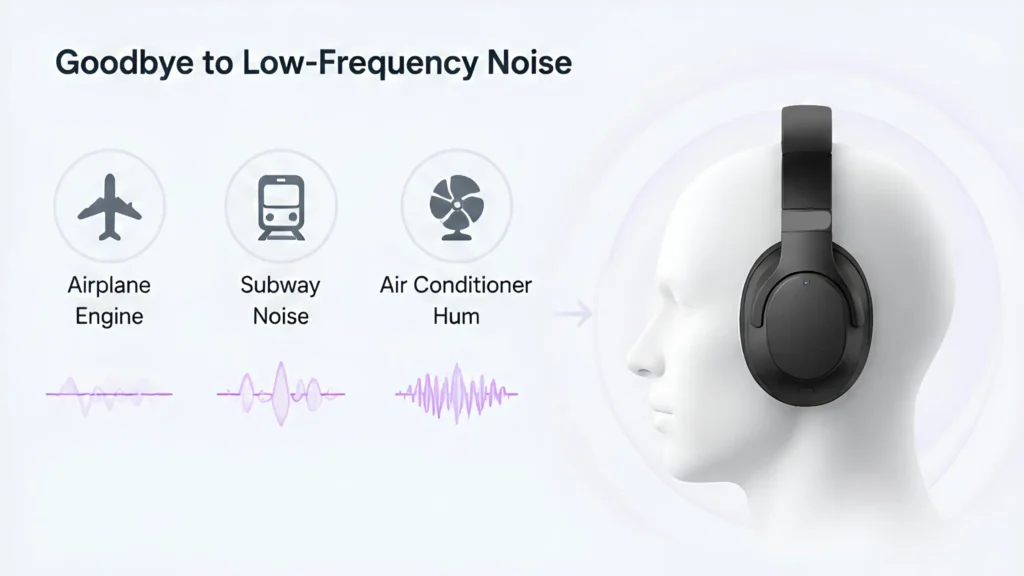
Low-Frequency Continuous Noise
This is where ANC earns its keep:
- Airplane engines
- Subway and train rumble
- Office HVAC systems
- Road and tire noise
These sounds are predictable. They repeat, they hold steady, and their waveform barely changes second to second. The processor can analyze the pattern, generate an accurate inverse and keep it locked in place. Constant noise is easy noise.
ANC Is Less Effective Against:
Sudden or high-frequency sounds:
- Keyboard clicks
- Nearby conversations
- Doors slamming and other sharp impacts
- Sudden clatter from a construction site
These change too fast. By the time the DSP has analyzed a keyboard click, the click is over. Speech is worse — it shifts pitch and volume constantly, and much of its energy sits in higher frequencies where the wavelengths are short and the timing tolerances brutal.
One more quirk worth knowing: in a genuinely quiet room, ANC has nothing to cancel and can make audio sound slightly unnatural. Standing in a park listening to birds? Switch it off.
How Does ANC Work in the fifine X3 Bluetooth Headphones?
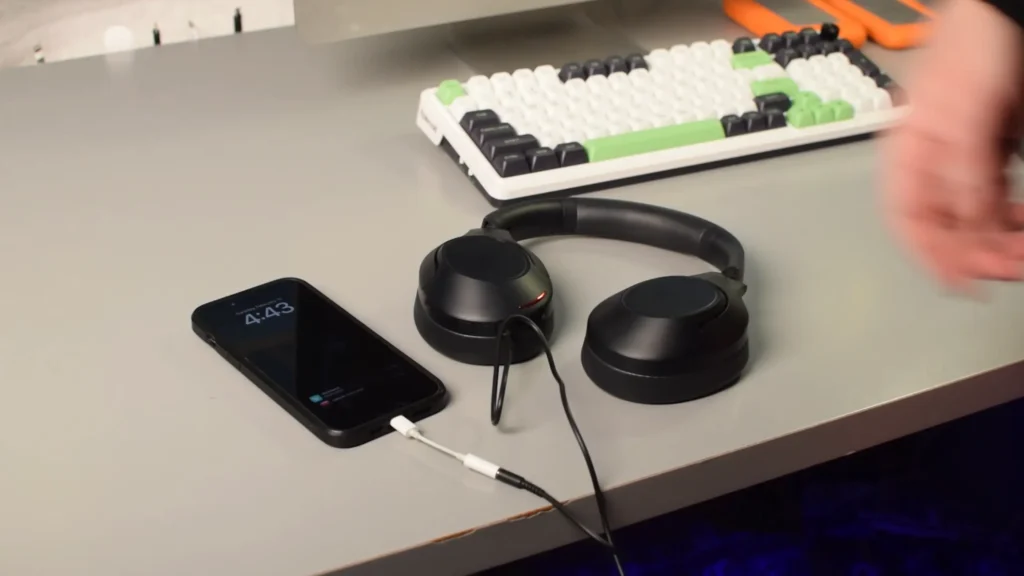
The X3 is a wireless over-ear headphone with active noise cancellation and transparency mode, running on Bluetooth 5.3 with a rated 65 hours of playtime and a 3.5mm jack for wired use.
Its ANC follows exactly the process above, and it starts from a good passive baseline. The fifine X3 wireless Bluetooth headphone uses memory foam ear cushions in a closed over-ear design, so a chunk of ambient noise is already reduced before the electronics do anything. The electronic layer then handles the low-frequency hum the foam can’t stop. It’s built for more focused video.
Where ANC in fifine X3 Headphone Helps
During commuting. Bus and train noise is the textbook ANC target — steady, low and relentless. With ANC on, you stop reaching for the volume dial every few minutes, which is better for your hearing over a long commute.
In the office or study space. Air conditioning, server fans, distant traffic through the window. None of it is loud enough to complain about; all of it wears you down over an eight-hour day. Removing that layer makes a measurable difference to how tired you feel by 5 p.m.
While traveling. Long-haul cabin drone is the single best argument for ANC ever made. The X3’s 65-hour rated battery and foldable build are built for exactly this kind of trip.
ANC vs Transparency Mode: Two Ways to Control Your Environment
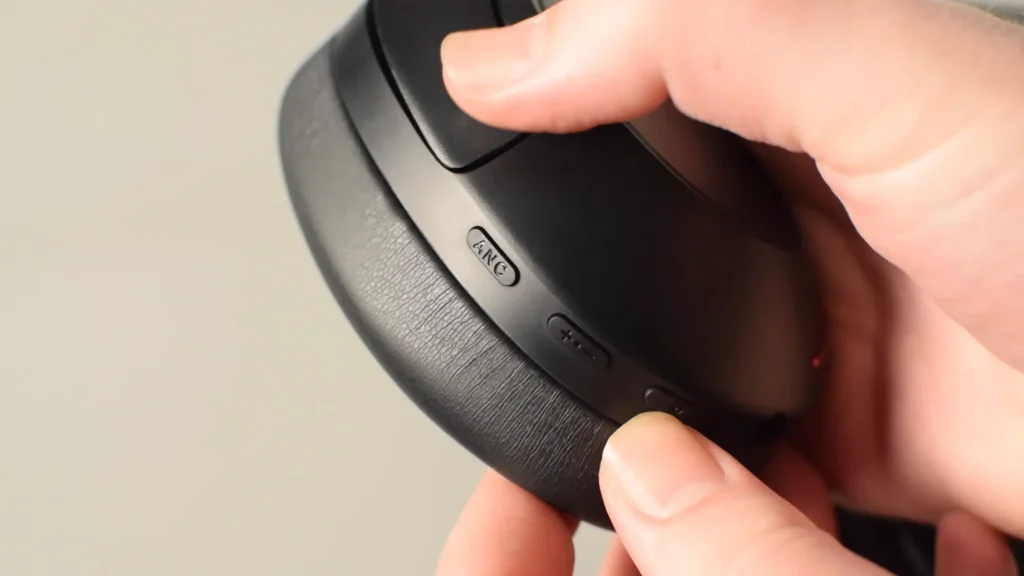
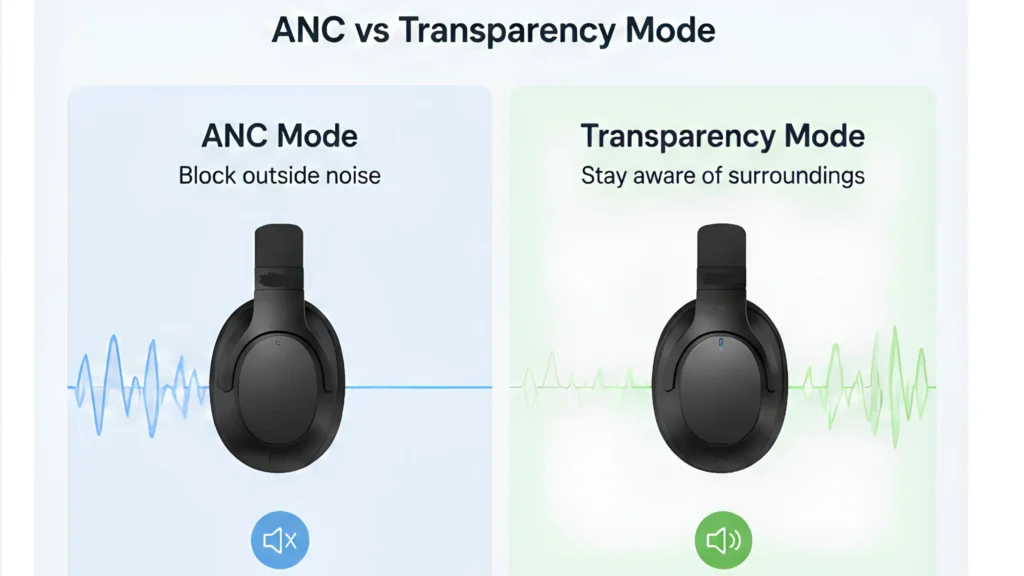
The fifine X3 wireless headphone is built with ANC and Transparency Mode. But they’re opposites.
ANC mode pushes external noise down. Use it when you want the world out — deep work, a flight, a noisy train car.
Transparency mode uses the same external microphones for the reverse job. Instead of generating anti-noise, it pipes ambient sound into the earcups so you can hear what’s around you without pulling the headphones off.
Transparency is more of a safety and convenience feature than an audio one. Crossing a street, waiting for a boarding announcement, ordering a coffee, catching a colleague’s question — all of it works better with transparency on than with ANC fighting the very sounds you need.
Does ANC Affect Sound Quality?
ANC reduces external noise. It doesn’t improve your audio.
But it changes what you can hear. Quiet passages, reverb tails, the decay on a snare — those details normally get buried under background noise. Strip the noise away, and they surface. Your music sounds better because less of it is being masked, not because the drivers got any better.
Sound quality itself still comes down to the fundamentals: headphone driver design like 40mm or 50mm, acoustic tuning, the Bluetooth codec in use, and the fit of the earcups on your head. ANC sits alongside those, not above them.
Some aggressive ANC tuning can slightly alter the frequency response on some headphones, which is why most listeners occasionally toggle it off in quiet rooms. Try both and trust your ears.
Final Words: Get a Smarter Listening Experience with ANC
Active Noise Cancellation (ANC) works through three things acting in concert: microphones that listen, a processor that analyzes, and drivers that generate an opposing wave. Destructive interference does the rest. It shines against constant, low-frequency noise, but struggles with speech and sudden sounds.
Paired with a solid passive design, though, ANC turns a noisy commute into something you can actually think through. With ANC and transparency mode built into the fifine X3 Bluetooth headphones, you get to choose which world you’re listening to.
FAQ
What does ANC mean on headphones?
Active Noise Cancellation (ANC) stands for active noise cancellation. The headphones use built-in microphones and a processor to generate a sound wave that cancels out ambient noise electronically.
How does active noise cancellation work?
Microphones capture external noise, a digital signal processor analyzes its frequency and waveform, and the headphones play back an inverted wave 180 degrees out of phase. The two waves cancel through destructive interference.
Is ANC better than passive noise isolation?
Neither replaces the other. Passive isolation handles mid and high frequencies through physical sealing; ANC handles low-frequency hum. The best results come from both working together.
Does ANC reduce audio quality?
ANC doesn’t improve audio, but it makes quiet details easier to hear by removing masking noise. Some listeners notice a small tonal shift with ANC engaged — switching it off in quiet rooms is easy enough.
When should I use ANC?
Use it in steady noise: planes, trains, buses, air-conditioned offices. Switch to transparency mode when you need to hear announcements, traffic or people, and switch ANC off entirely in already-quiet spaces.
